
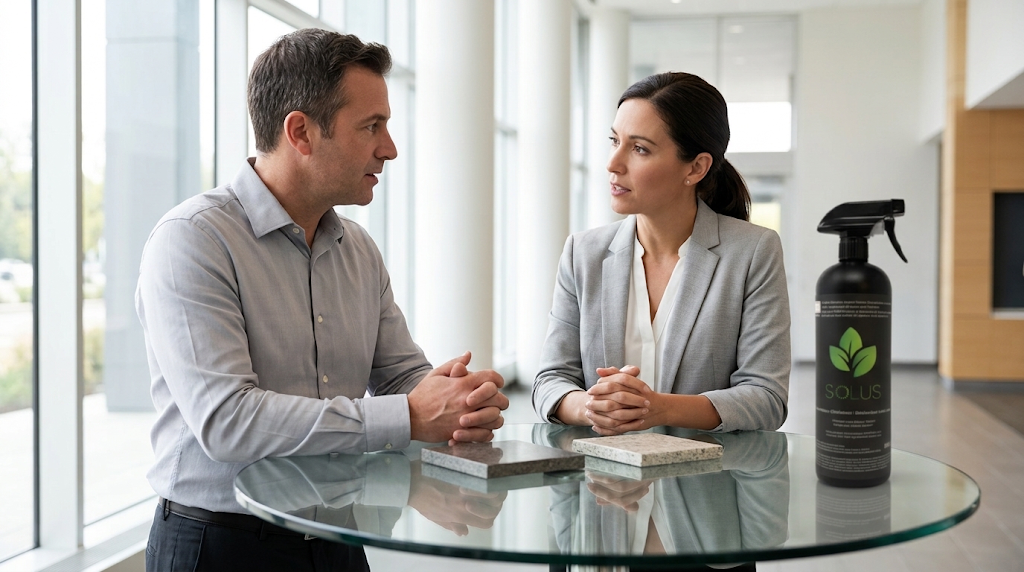
Direct answer
No disinfectant is truly “non-toxic” — a product is regulated as a disinfectant precisely because it acts on microorganisms. The useful goal is a lower-toxicity handling profile when used as directed: product-specific handling instructions, label-led rinsing and a clear Health Canada authorization. For handling, follow the PPE requirements on the current product label and SDS. This guide compares the common disinfectant classes on those terms so a Canadian facility can choose the one that fits its surfaces and workflow.
For this guide’s place within the wider topic, see our hypochlorous acid resource hub.
Key takeaways
- “Non-toxic” is a search term, not a literal product state; the practical measure is a lower-toxicity handling profile when used as directed.
- Compare disinfectant classes on four things: handling/PPE, residue, material compatibility, and Health Canada authorization for your use area.
- For hypochlorous acid (HOCl) products, follow the PPE requirements on the current product label and SDS; confirm pH, rinsing and residue-management instructions for the specific formulation.
- Whatever the class, the current label is the operating authority — authorized surfaces, contact times and any required rinse.
- Solus’s Multi-Purpose Disinfectant is a near-neutral HOCl disinfectant with Health Canada biocide market authorization no. 02557371 and documented GLP evidence.
On this page
- What does “non-toxic disinfectant” really mean?
- How to compare disinfectants fairly
- The main disinfectant classes, compared
- Where HOCl fits
- How to choose for your facility
- Frequently asked questions
No disinfectant is truly non-toxic — the honest goal is lower-toxicity handling when used as directed, backed by a real authorization and the label.
— Philippe Mathys, Solus
What does “non-toxic disinfectant” really mean?
Buyers search for a “non-toxic disinfectant,” but no product that disinfects is non-toxic in an absolute sense — it is regulated because it acts on microorganisms. A more useful framing is lower-toxicity when used as directed: does the product need heavy PPE, does it leave a residue that must be rinsed, does it off-gas harsh fumes, and is it authorized for your use? Médecins Sans Frontières describes hypochlorous acid generally as “non-toxic, non-corrosive” in a 2025 WHO Essential Medicines List submission — an attributed description of the compound, not a blanket product claim.
For a closer look at handling claims, see Is hypochlorous acid safe?.
How to compare disinfectants fairly
Judge a class, and then the specific product’s label, on four practical factors:
- Handling and PPE — what the SDS requires for routine use.
- Residue and rinsing — whether the label requires a rinse, especially on food-contact surfaces.
- Material compatibility — corrosivity and effect on metals, plastics and coatings.
- Authorization — a current Health Canada authorization for the surfaces and premises you need.
These factors matter more than the word “non-toxic” on a label.
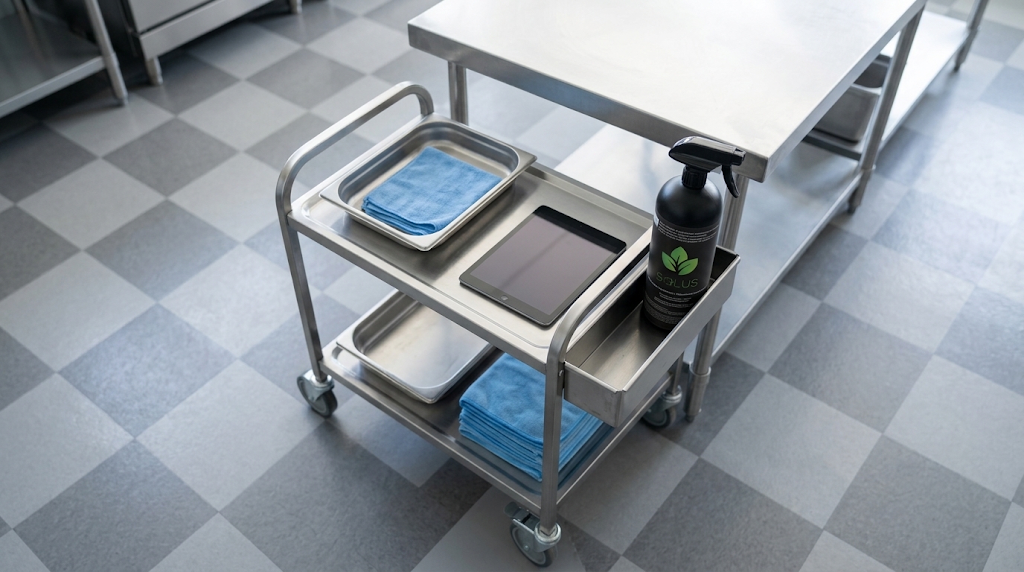
The main disinfectant classes, compared
| Class | Handling profile | Residue / rinse | Notes |
|---|---|---|---|
| Hypochlorous acid (HOCl) | Follow the PPE requirements on the current product label and SDS; verify the formulation’s pH and ventilation requirements | Follow the current label for residue management and food-contact rinsing | Stability and authorization vary by product |
| Chlorine bleach (hypochlorite) | High-pH; ventilation and PPE typically needed; strong odour | Residue; rinse often required | Follow the specific formulation’s handling requirements |
| Quaternary ammonium (quats) | Varies by product | Tends to leave residue (EPA 2024) | Resistance concerns discussed in the literature |
| Hydrogen peroxide / accelerated H2O2 | Varies; follow the product label and SDS for ventilation | Follow the product label for residue management and rinsing | Concentration-dependent handling |
| Alcohols | Flammable; evaporate quickly | Verify residue and required wet contact time on the label | Best for small surfaces; not all pathogens |
General class comparison; always compare the specific product labels and SDS. Data last verified: August 2026.
For product-specific comparisons, see HOCl vs bleach and HOCl vs Quaternary Ammonium (Quats).
Where HOCl fits
For hypochlorous acid products, follow the PPE requirements on the current product label and SDS and verify the formulation’s pH, ventilation and residue-management instructions. That does not make it “non-toxic,” and it does not remove label-led steps — including a potable-water rinse for food-contact and direct-contact surfaces. Stability and authorization still vary between HOCl products, so the label and Health Canada authorization remain the deciding details.
How to choose for your facility
Start from your surfaces and use area, then match the product’s current label and authorization to them. Confirm the handling and PPE in the SDS, the residue/rinse steps on the label, material compatibility for your equipment, and that the Health Canada authorization covers your premises category. A “lower-toxicity” choice is the product whose label and SDS genuinely support easier handling for your workflow — not the one with the boldest adjective.
Solus’s Multi-Purpose Disinfectant is a near-neutral HOCl disinfectant made in Canada, holding Health Canada biocide market authorization no. 02557371, with a 367 ppm label concentration and GLP-tested evidence (Analytical Lab Group). It offers a lower-toxicity handling profile when used as directed and is not WHMIS-regulated (SDS §15). Follow the PPE requirements on the current product label and SDS, and use it only on authorized hard surfaces as directed.
Comparing options for your facility? See the Solus product range and the product documentation.
Solus ships within Canada only.
Frequently asked questions
Is there such a thing as a truly non-toxic disinfectant?
No. Any product that disinfects is regulated because it acts on microorganisms, so none is “non-toxic” in an absolute sense. The practical measure is a lower-toxicity handling profile when used as directed . Follow the PPE requirements on the current product label and SDS, including the label’s rinsing and ventilation directions.
Which disinfectant has the lowest-toxicity handling profile?
It depends on the specific product’s label and SDS. For hypochlorous acid (HOCl) and every other class, follow the PPE requirements on the current product label and SDS; assess ventilation, surface compatibility and rinsing for the intended task. Compare each product’s label, SDS and Health Canada authorization.
What should I compare when choosing a disinfectant in Canada?
Compare handling/PPE (SDS), residue and rinsing (label), material compatibility, and whether the product has a current Health Canada authorization for your use area. These matter more than the word “non-toxic.”
Does a lower-toxicity disinfectant still need rinsing?
Follow the label. Many products, including Solus, recommend a potable-water rinse for surfaces that may contact food, infants or toddlers, animals, feed or drinking water. Lower-toxicity handling does not remove a label-led rinse.
Is Solus a non-toxic disinfectant?
Solus describes its Multi-Purpose Disinfectant as a lower-toxicity option when used as directed — not as absolutely non-toxic. “Non-toxic, non-corrosive” appears only as MSF’s attributed description of hypochlorous acid. Follow the current label and SDS.
Final thoughts
“Best non-toxic disinfectant” is really a search for a lower-toxicity handling profile that still does the job and is properly authorized. Compare classes and specific labels on handling, residue, compatibility and authorization. Solus’s Multi-Purpose Disinfectant is a near-neutral HOCl option with Health Canada biocide market authorization no. 02557371, GLP evidence, and a lower-toxicity handling profile when used as directed — label-led, on authorized hard surfaces.
See also
Sources
- Médecins Sans Frontières, WHO Essential Medicines List submission (attributed “non-toxic, non-corrosive”).
- U.S. EPA, “EPA Releases Finalized Test Methods for Measuring Disinfectant Residue Levels on Hard Surfaces,” June 13, 2024 — quaternary ammonium compounds are expected to leave the most residue on treated surfaces after a potable-water rinse. https://www.epa.gov/pesticides/epa-releases-finalized-test-methods-measuring-disinfectant-residue-levels-hard-surfaces
- Solus biocide market authorization no. 02557371, current label and SDS §8/§15; documented Analytical Lab Group GLP report references A30442, A30618 and A31073.