
Direct answer
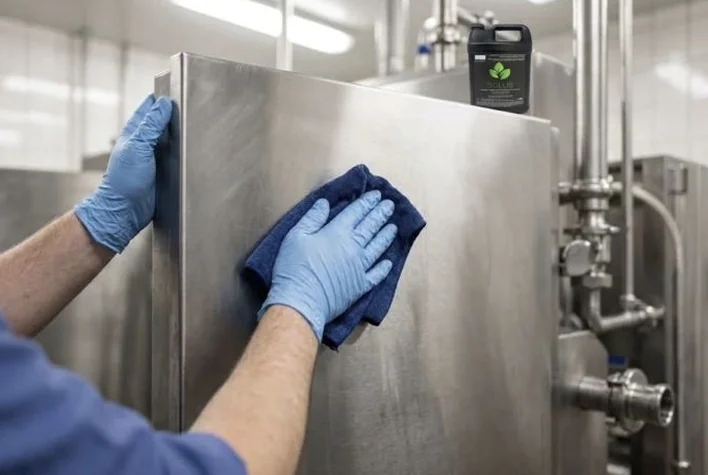
Dairy-equipment disinfection starts after complete soil removal. The procedure must reach clean, hard, non-porous equipment surfaces for the full label contact time. Solus’s Multi-Purpose Disinfectant holds Health Canada biocide market authorization no. 02557371 for Food Premises. Food-contact surfaces require a potable-water rinse according to the current label.
For an overview, see our hypochlorous acid (HOCl) guide.
Key takeaways
- Dairy soil must be removed before disinfectant contacts accessible, smooth, drainable stainless surfaces; the inspection must be documented.
- Solus’s Multi-Purpose Disinfectant uses a current label concentration of 367 ppm.
- Food-contact surfaces require a potable-water rinse according to the current label.
- Analytical Lab Group GLP reports support five organisms and specified contact times.
- MSF describes hypochlorous acid as “non-toxic, non-corrosive” in its WHO submission.
On this page
- What does dairy-equipment surface disinfection require?
- Is HOCl appropriate for stainless dairy equipment?
- Why must food-contact surfaces be rinsed?
- What does the tested evidence show?
- How does the disinfectant fit a dairy routine?
- Where does the scope stop?
- Frequently asked questions
In a milk room it always comes back to the same discipline: clean the stainless first, hold the label contact time, then rinse where the label says.
— Philippe Mathys, Solus
What does dairy-equipment surface disinfection require?
Milk proteins, fats, mineral deposits, and processing soil can shield a surface from a disinfectant. A reliable procedure therefore separates cleaning from disinfection. Operators first stop and isolate the equipment, remove product, disassemble accessible parts, and clear gross soil. The validated cleaning method then removes the remaining film. Rinsing carries away detergent and loosened soil. A visual check confirms that joints, gaskets, valves, filler heads, and shadowed areas are clean before disinfection begins.
Equipment design controls whether that sequence can work. CFIA guidance emphasizes smooth, corrosion-resistant food-contact surfaces, accessible components, drainage, and the absence of cracks or dead ends. A clean-in-place circuit also needs monitored time, temperature, flow, and chemical concentration. A spray ball cannot compensate for a blocked return line, and a clean exterior does not prove that an enclosed circuit is clean. The plant’s preventive-control plan should identify which surfaces use CIP and which need manual access.
The disinfection step begins only after the surface is clean. Apply the product at its label concentration, wet the complete target surface, and maintain the listed contact time. A dry patch restarts the step rather than receiving a partial pass. The record should capture the equipment or line, pre-clean result, product, concentration, start and finish times, rinse completion, verification, corrective action, operator, and supervisor sign-off.
Is HOCl appropriate for stainless dairy equipment?
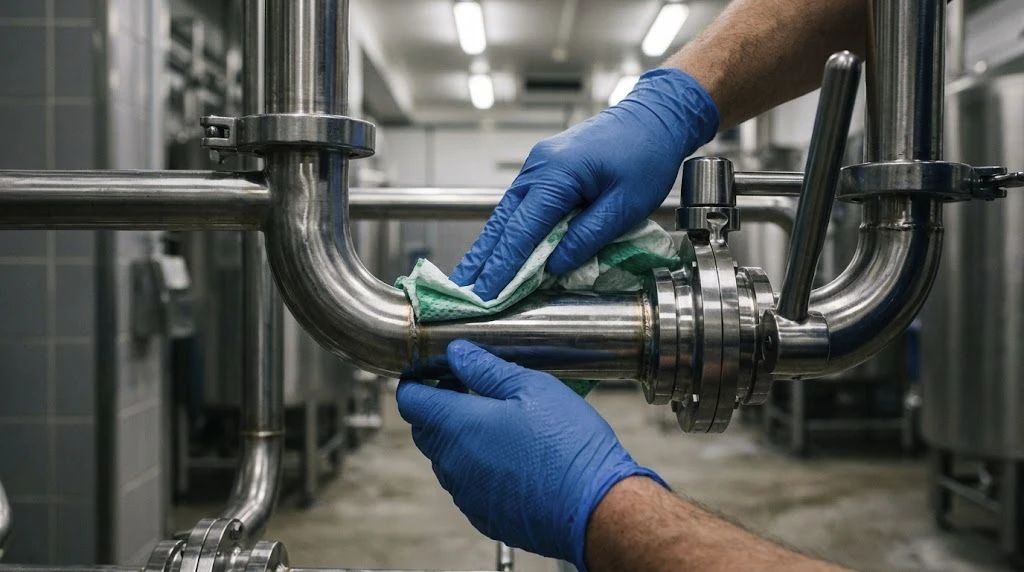
Stainless steel is widely used because a sound surface is smooth, non-absorbent, corrosion resistant, and repeatedly cleanable. Near-neutral hypochlorous acid can fit that material strategy, but pH alone is not a blanket compatibility guarantee. Solus’s Multi-Purpose Disinfectant has a pH of 5.0–7.0 and an oxidation-reduction potential of +600 to +1200 mV (SDS §9). Operators must still follow the current label, equipment manufacturer instructions, and the facility’s compatibility review.
Médecins Sans Frontières describes hypochlorous acid as “non-toxic, non-corrosive” in its WHO Essential Medicines List submission. That statement describes the compound in the cited submission; it is not a first-party Solus product guarantee. Weld quality, surface finish, exposure frequency, temperature, mixed chemicals, chlorides, gaskets, and trapped solution can all affect real equipment. A facility should never mix the product with another chemical or infer compatibility for elastomers and coatings from stainless steel alone.
A practical qualification starts with one defined surface. Confirm that the surface is hard and non-porous, review the equipment manual, test an inconspicuous area if required, and inspect for pitting, staining, damaged seals, or trapped liquid after the first cycles. Record the approved application method. This keeps “material friendly” from becoming an unsupported promise and turns compatibility into a managed part of the sanitation program.
What does the tested evidence show?
The complete product-specific efficacy set appears below. The results apply to the named organisms, protocols, contact times, and reports only.
| Organism | ATCC | Protocol and laboratory | Contact time | Report |
|---|---|---|---|---|
| Staphylococcus aureus | 6538 | AOAC Use Dilution Method; Analytical Lab Group GLP | 10 minutes | A30442 |
| Salmonella enterica | 10708 | AOAC Use Dilution Method; Analytical Lab Group GLP | 10 minutes | A30442 |
| Pseudomonas aeruginosa | 15442 | AOAC Use Dilution Method; Analytical Lab Group GLP | 10 minutes | A30442 |
| Human Coronavirus 229E | VR-740 | Virucidal efficacy on inanimate surfaces; Analytical Lab Group GLP | 1 minute | A30618 |
| Influenza A H1N1 | VR-1469 | Virucidal efficacy on inanimate surfaces; Analytical Lab Group GLP | 1 minute | A31073 |
Data last verified: August 2026.
The AOAC Use Dilution Method is a pass/fail carrier test. The result should not be converted into a percentage or log-reduction claim. Salmonella enterica is relevant context for food facilities, but the result does not replace the plant’s hazard analysis. Influenza A H1N1 is a human influenza strain. The report does not support an animal-influenza, avian-influenza, veterinary, or herd-health claim. For the facility boundary around poultry, see the poultry-barn disinfection guide.
Why must food-contact surfaces be rinsed after disinfection?
Food Premises authorization covers disinfection of the equipment surface; it does not authorize direct application to milk or another food. The current label governs the reset step. After the required contact time, rinse food-contact surfaces with potable water before production resumes. A filler nozzle, product-side valve, open vat, transfer hose fitting, and conveyor surface all need that food-contact decision even when the surrounding frame does not.
The rinse is not evidence that the disinfection failed. The rinse completes the label-led procedure and removes remaining solution before food returns. Operators should distinguish the potable-water rinse from the earlier cleaning rinse. The first rinse removes detergent and soil before disinfection. The final rinse occurs after label contact time on food-contact surfaces. Combining the two steps can shorten wet contact time or reintroduce soil.
Verification should be observable. A supervisor can check the timestamp, water source, rinse completion, drainage, and line-release status. The plant may also use its validated pre-operational inspection or environmental-monitoring program. Do not write “no residue” as a reason to skip the rinse. A residue-conscious chemistry does not override the current label, and a product used on hard surfaces is not being applied to milk, udders, animals, feed, or drinking water.
How does the disinfectant fit into a dairy sanitation routine?
Start with a surface-specific SSOP rather than a generic “disinfect equipment” instruction. For a stainless filler head, the SSOP can identify shutdown and lockout, disassembly points, gross-soil removal, detergent parameters, first rinse, visual inspection, application at 367 ppm, the applicable label contact time, potable-water rinse, drainage, reassembly, and release. Each step should name a responsible role and a record field.
Control the boundary between raw and ready-to-package areas. Separate tools, hoses, cloths, and carts where the preventive-control plan requires it. If one CIP system serves different circuits, follow the validated sequence established by the processor. Do not use a surface disinfectant to compensate for a faulty valve, cracked gasket, dead leg, inadequate turbulent flow, or missed manual-cleaning point. Maintenance findings belong in corrective action, not in a longer chemical exposure.
The current label concentration is 367 ppm free available chlorine. Verify concentration by the facility’s approved method and frequency. Apply enough solution to wet the complete target and prevent premature drying. If a surface dries before the label contact time, the operator documents the deviation, reapplies the product, restarts the timer, completes the potable-water rinse where required, and obtains supervisor release. That sequence gives an auditor a traceable control rather than a checkmark without evidence.
Building a dairy-equipment SSOP? Review the Solus product range for available formats, then match every use to the current label.
Where does the scope stop?
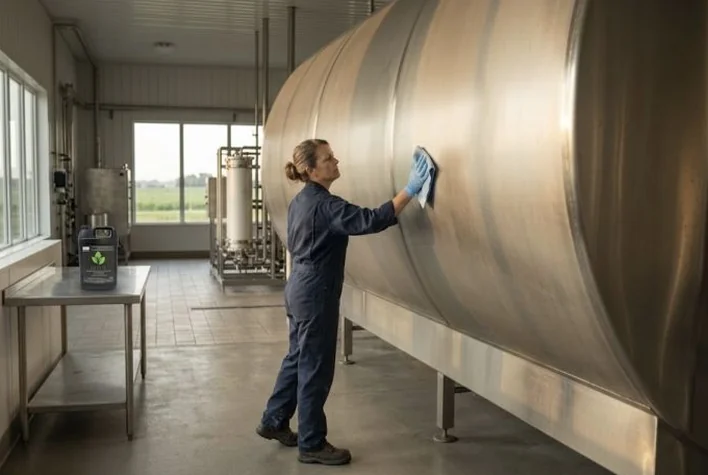
This article covers hard, non-porous surfaces on dairy-processing and food-handling equipment in a Food Premises setting. The article does not authorize use on milk, udders, animals, feed, drinking water, skin, wounds, or porous materials. The article does not establish sterilization, clean-in-place validation, or compatibility for every alloy, gasket, coating, or machine. For wider farm-zone boundaries, see the livestock biosecurity guide.
The plant’s preventive-control plan, current product label, equipment instructions, and validated sanitation procedure control the actual use. Food-contact surfaces require the label’s potable-water rinse. A dairy facility should stop and use a different authorized process when the target, material, hazard, or application route falls outside those boundaries.
Frequently asked questions
Can HOCl replace cleaning on dairy equipment?
No. Dairy soil must be removed before surface disinfection. Cleaning removes proteins, fats, mineral deposits, and other material that can block complete surface contact. Solus’s Multi-Purpose Disinfectant is applied only after the hard, non-porous surface passes the facility’s pre-clean check.
Is HOCl non-corrosive on stainless steel?
MSF describes hypochlorous acid as “non-toxic, non-corrosive” in its WHO submission. Solus’s Multi-Purpose Disinfectant has a near-neutral pH of 5.0–7.0. Operators must still follow the label, equipment instructions, compatibility review, and inspection program for each stainless surface and component.
Must dairy food-contact surfaces be rinsed?
Yes. The current label requires a potable-water rinse for food-contact surfaces after the applicable contact time. The final rinse applies before milk or another food returns. The product is never applied directly to milk, udders, animals, feed, or drinking water.
What concentration does the current label specify?
The current label concentration is 367 ppm free available chlorine. The facility should use its approved concentration-verification method and record the result. The label contact time, full wetting, potable-water rinse, and release checks remain separate requirements.
Which organisms support the efficacy claim?
Analytical Lab Group GLP reports cover five named organisms. The lab reports pair every organism with an ATCC identifier, protocol, contact time, and report number. The evidence does not support mould, yeast, fungi, biofilm, animal-pathogen, or bare percentage claims.
Final thoughts
Dairy-equipment disinfection is a controlled surface procedure, not a chemical shortcut. A sound routine removes dairy soil, exposes cleanable surfaces, applies the label concentration, maintains complete wet contact, rinses food-contact surfaces with potable water, and records release. Solus’s Multi-Purpose Disinfectant can occupy that defined step when the Food Premises surface and procedure match the current label.
See also
- Commercial kitchen disinfection — operational food-contact distinction
- HACCP-compliant disinfectant — sanitation-record context
- Solus documents and authorization — plain text; linked once above
- Solus product range — plain text; linked once in the CTA
Sources
- Canadian Food Inspection Agency, dairy equipment design.
- Canadian Food Inspection Agency, dairy processor practices.
- Solus biocide market authorization no. 02557371 and current label.
- Solus SDS/FDS §§3, 8, 9, 14, 15; preparation date July 29, 2026.
- Analytical Lab Group GLP reports A30442, A30618, and A31073.
- Médecins Sans Frontières, WHO Essential Medicines List submission — attributed compound wording only.