
Direct answer
Poultry-barn disinfection covers clean, hard, non-porous facility surfaces during an empty-barn interval. Solus’s Multi-Purpose Disinfectant holds Health Canada biocide market authorization no. 02557371 for Institutional and Industrial use areas. The product is not applied to birds, feed, or water. Pathogen-specific animal uses require an appropriate PMRA-registered product.
For an overview, see our hypochlorous acid (HOCl) guide.
Key takeaways
- Between-flock work starts with bird removal, dry cleaning, washing, drying, and inspection; the product targets authorized hard, non-porous facility surfaces only (current label).
- Solus’s Multi-Purpose Disinfectant uses a current label concentration of 367 ppm.
- Five human or general test organisms support the product-specific evidence; Influenza A H1N1 is a human strain, not an avian-influenza claim (Analytical Lab Group reports A30442, A30618, A31073).
- “Biosecurity” describes the farm program; it does not describe the Multi-Purpose Disinfectant’s efficacy.
- Uses involving birds, feed, water, animal health, or specific farm pathogens require an appropriately authorized product (current label and PMRA scope).
On this page
- What does poultry-barn surface disinfection cover?
- Which poultry-barn surfaces are in scope?
- How does the Multi-Purpose Disinfectant fit?
- What does the tested evidence show?
- Where does the scope stop?
- How do you build a between-flock routine?
- Frequently asked questions
Between flocks the win is a clean, hard surface and a record that proves it — not a claim that a disinfectant does the barn’s biosecurity for you.
— Philippe Mathys, Solus
What does poultry-barn surface disinfection cover?
The Canadian on-farm biosecurity standard places cleaning and disinfection inside a broader program covering premises, buildings, equipment, vehicles, people, and flock movement. In this article, “biosecurity” explains why a producer controls facility surfaces. It does not mean the disinfectant prevents an animal disease or carries a pathogen-specific poultry claim.
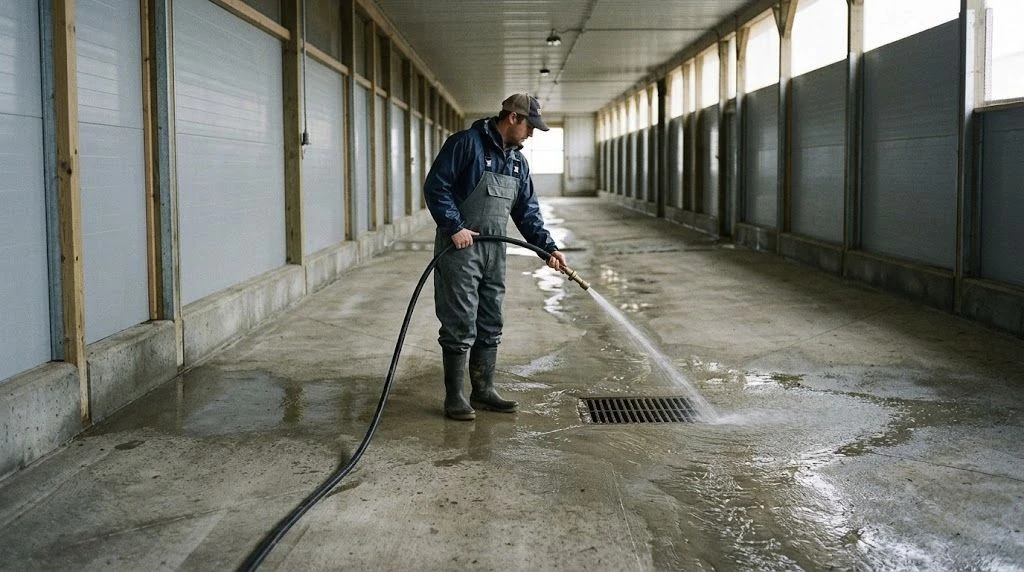
A between-flock interval creates access that is not available in an occupied barn. Remove the flock according to the farm plan, remove litter and manure, dry-clean ledges and equipment, complete required repairs, wash from high areas toward drains, and allow surfaces to dry before inspection. Organic debris cannot be covered with disinfectant and called complete. It blocks contact, consumes chemistry, and conceals cracks, damaged sealant, or inaccessible material.
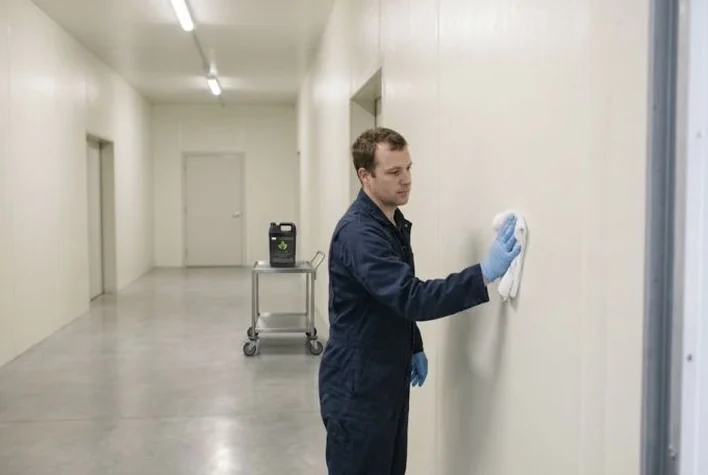
The surface-disinfection step starts only after the target is clean and suitable. Confirm that it is hard and non-porous, apply the current label concentration, fully wet the surface, and maintain the listed contact time. A surface that dries early must be rewetted and retimed. Plan ventilation, drainage, wastewater handling, and a clean-to-dirty work path. The procedure should also prevent workers, hoses, tools, carts, or footwear from recontaminating completed areas before the next flock enters.
Which poultry-barn surfaces are in scope?
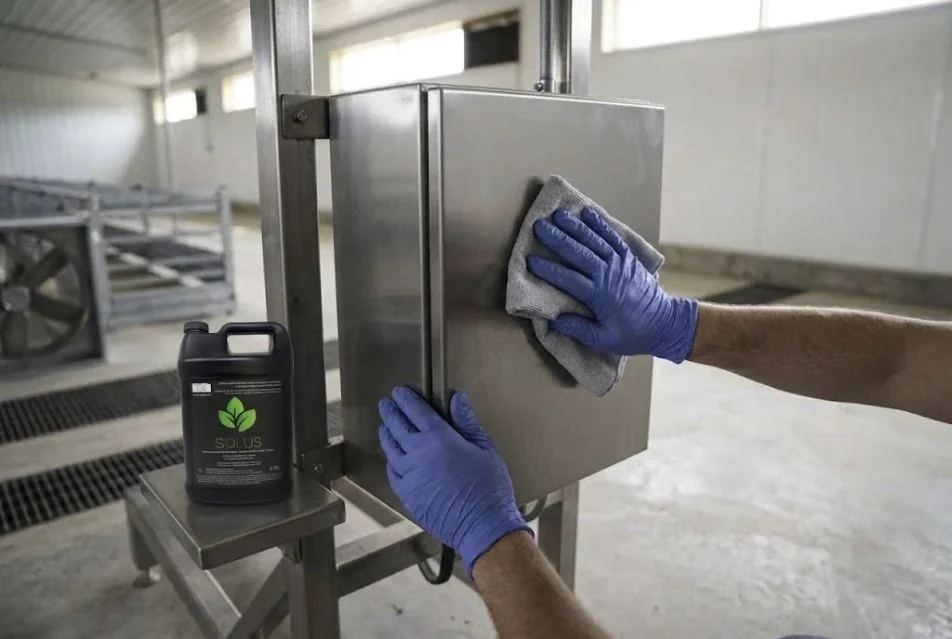
Start with facility surfaces that are hard, non-porous, cleanable, accessible, and included by the current label. Examples may include sealed wall panels, coated doors, door handles, service-room counters, equipment frames, fan housings, guards, control-box exteriors, washable cart handles, and hard surfaces in an anteroom. Confirm material compatibility and power isolation before treating electrical or mechanical equipment.
Do not classify a surface only by its location. An unsealed wooden perch, cracked concrete, insulation, litter, fabric, cardboard, or another porous material does not become an authorized hard-surface target because it sits inside the barn. A feed-contact component or watering component also needs a different decision from an exterior equipment frame. The product is not applied to feed or drinking water, and any surface with food, water, animal, or body contact requires the current label’s applicable directions, including potable-water rinsing where required. For milk-processing equipment, see the dairy-equipment disinfection guide.
Map the barn by zones: flock area, service room, transition or anteroom, equipment storage, loading point, and exterior wash area. The map prevents a broad instruction such as “spray the barn” from hiding exclusions. Assign one method to each target, specify whether disassembly is required, and identify surfaces that need another authorized process. The surface list should be reviewed after equipment changes, repairs, or a failed inspection.
What does the tested evidence show?
The product-specific evidence covers only the five organisms below. None is an avian-influenza or poultry-disease claim.
| Organism | ATCC | Protocol and laboratory | Contact time | Report |
|---|---|---|---|---|
| Staphylococcus aureus | 6538 | AOAC Use Dilution Method; Analytical Lab Group GLP | 10 minutes | A30442 |
| Salmonella enterica | 10708 | AOAC Use Dilution Method; Analytical Lab Group GLP | 10 minutes | A30442 |
| Pseudomonas aeruginosa | 15442 | AOAC Use Dilution Method; Analytical Lab Group GLP | 10 minutes | A30442 |
| Human Coronavirus 229E | VR-740 | Virucidal efficacy on inanimate surfaces; Analytical Lab Group GLP | 1 minute | A30618 |
| Influenza A H1N1 | VR-1469 | Virucidal efficacy on inanimate surfaces; Analytical Lab Group GLP | 1 minute | A31073 |
Data last verified: August 2026.
The AOAC Use Dilution Method reports pass or fail, not a percentage or log reduction. Salmonella enterica can provide relevant farm and food-setting context, but the laboratory result does not authorize a poultry-health claim. Influenza A H1N1 is a human influenza strain. It must never be presented as avian influenza. No result in this table supports coccidia, avian pathogens, mould, fungi, spores, biofilm, pest control, or veterinary treatment.
How does the Multi-Purpose Disinfectant fit the routine?
Solus’s Multi-Purpose Disinfectant can fill one defined step: disinfection of clean, hard, non-porous agricultural-facility surfaces covered by the Institutional and Industrial use areas. The label concentration is 367 ppm free available chlorine. Product choice does not replace dry cleaning, washing, inspection, drying, or repair. It also does not make the poultry vertical itself a named authorization.
The product’s handling profile may support an operational routine. The SDS lists a pH of 5.0–7.0 and an ORP of +600 to +1200 mV (§9). Follow the PPE requirements on the current product label and SDS; eye protection is recommended where splashing is possible, and gloves suit prolonged or repeated contact or sensitive skin (§8). Those statements remain subordinate to the label, farm procedure, task assessment, and any site-specific protective requirements.
Use a work order that names the zone, target surfaces, product and concentration, operator, application time, finish time, rewetting event, applicable rinse, inspection, and release. Separate clean tools from dirty tools. Apply from the cleanest zone outward and maintain a boundary around finished areas. The result is a repeatable hard-surface procedure, not a promise that the product controls an unnamed barn pathogen.
Where does the scope stop?
The scope stops at authorized, hard, non-porous surfaces in an empty agricultural or industrial facility. Do not apply the product to birds, eggs, skin, wounds, feathers, feed, litter, bedding, drinking water, water medication systems, or porous building materials. Do not present the product as a veterinary disinfectant, animal-health product, flock treatment, avian-influenza control, or pathogen-specific biosecurity intervention.
“Biosecurity” describes the operational reason a farm cleans and disinfects surfaces. The word does not expand the product’s authorized use area or tested organism set. If the farm needs a claim against a named animal pathogen, a pest, a water-system organism, or an application involving animals, feed, or water, the farm must select an appropriately authorized or PMRA-registered product and follow that product’s label. Veterinary advice and outbreak instructions also remain separate from this surface procedure.
Any food-, drinking-water-, animal-, or body-contact surface requires a label-level decision and any required potable-water rinse. The absence of birds during downtime does not turn an excluded surface or application into an authorized one. When the target cannot be clearly classified, stop the task and obtain the current label or regulatory guidance before proceeding.
How do you build a between-flock surface routine?
Begin with a documented release from flock operations and a defined dirty-to-clean flow. Remove mobile equipment, litter, manure, dust, and loose debris. Complete repairs while defects are visible. Wash the structure and approved equipment, manage runoff, and allow surfaces to dry. Inspect from ceilings and air inlets down to walls, guards, frames, sealed floors, doors, and transition areas. Reclean any point that still shows soil.
Next, stage only clean application equipment. Verify the product and 367 ppm label concentration. Treat one mapped zone at a time, maintain full wet contact, and record any reapplication caused by premature drying. Follow applicable label rinse directions. Allow required drying and downtime, then prevent re-entry by dirty tools, service personnel, rodents, vehicles, or equipment. Reinstall only cleaned equipment.
The supervisor’s release should reconcile the surface map with the work record. A missed control-box exterior, damaged wall seam, or dirty anteroom floor becomes corrective action. The operator records the recleaning, reapplication, contact time, and verification. Trend repeated misses between flock cycles. That feedback improves the routine without overstating what the disinfectant itself can do.
Planning a between-flock hard-surface routine? Review the Solus product range and match every surface and method to the current label.
Frequently asked questions
Can the product be sprayed while birds are in the barn?
This article does not support that use. The procedure covers authorized hard, non-porous facility surfaces during an empty-barn interval. Do not apply the product to birds, feed, litter, bedding, or drinking water. Follow the current label and the farm’s approved between-flock procedure.
Does the H1N1 report cover avian influenza?
No. Influenza A H1N1 (ATCC VR-1469) is a human influenza strain tested on inanimate surfaces in Analytical Lab Group report A31073. The result does not support avian-influenza, poultry-disease, animal-health, or pathogen-specific biosecurity efficacy claims.
Can the product disinfect feeders or waterers?
Do not apply the product to feed or drinking water. A component’s exterior may qualify only when it is an authorized hard, non-porous surface and the current label supports the method. Contact surfaces require the label’s applicable potable-water rinse. Use another authorized process when the target falls outside scope.
What must happen before surface disinfection?
Workers remove the flock, litter, manure, dust, and visible soil. The barn is washed, allowed to dry, repaired where needed, and inspected. Disinfection begins only when the mapped hard, non-porous target is clean and accessible for complete wet contact.
What product evidence can the farm cite?
The Solus lab reports cover five named organisms with ATCC identifiers, protocols, contact times, Analytical Lab Group GLP status, and report numbers. The evidence does not cover avian pathogens, animal disease, mould, biofilm, or bare kill percentages.
Final thoughts
A credible poultry-barn procedure defines the surface, sequence, contact time, boundary, and limit. Solus’s Multi-Purpose Disinfectant can support hard, non-porous surface disinfection within an Institutional or Industrial facility when the current label matches. The product is not used on birds, feed, or water and does not carry an animal-health or biosecurity-efficacy claim.
See also
- Agriculture surface disinfection — current sector page
- Is HOCl safe? — handling evidence
- Solus documents — plain text; linked once above
- Solus product range — plain text; linked once in the CTA
Sources
- Canadian Food Inspection Agency, avian biosecurity standard.
- Canadian Food Inspection Agency, poultry biosecurity guide.
- Solus biocide market authorization no. 02557371 and current label.
- Solus SDS/FDS §§8, 9, 14, 15; preparation date July 29, 2026.
- Analytical Lab Group GLP reports A30442, A30618, and A31073.