
Direct answer
Livestock biosecurity uses cleaning and surface disinfection to manage movement between farm zones. Solus’s Multi-Purpose Disinfectant holds Health Canada biocide market authorization no. 02557371 for Institutional and Industrial use areas. The product targets authorized hard, non-porous facility surfaces only. The product is not applied to animals, feed, or water.
For an overview, see our hypochlorous acid (HOCl) guide.
Key takeaways
- Biosecurity describes a farm system, not a disinfectant efficacy claim; animal, feed, water, veterinary, and pathogen-specific uses remain outside scope.
- Workers remove manure, bedding, soil, and wash water before surface disinfection.
- Solus’s Multi-Purpose Disinfectant uses a current label concentration of 367 ppm.
- The product-specific evidence covers five named laboratory organisms only.
- Farm records should connect zones, groups, equipment movement, contact time, and release.
On this page
- What does biosecurity mean for surface disinfection?
- Which farm surfaces are in scope?
- How does the Multi-Purpose Disinfectant fit?
- What does the tested evidence show?
- Where does the scope stop?
- How do you build a between-group routine?
- Frequently asked questions
Biosecurity is the farm’s whole system; the product does one honest part of it — label-led disinfection of clean, hard, non-porous surfaces.
— Philippe Mathys, Solus
What does biosecurity mean for surface disinfection?
Biosecurity is a farm management system that controls how animals, people, vehicles, equipment, materials, and waste move between zones. Cleaning and disinfection support that system by removing soil and treating suitable environmental surfaces. The term does not mean that a surface disinfectant prevents a livestock disease or protects a herd against every pathogen. For flock-specific planning, see the poultry-barn disinfection guide.
A useful plan defines zones before it defines chemicals. The farm can separate public access, controlled access, production groups, isolation or hospital areas, maternity areas, loading points, manure routes, wash stations, and clean storage. Each boundary needs a movement rule. A loader used near manure storage should not return to a feed-handling route without the farm’s approved cleaning and transition process. A visitor vehicle and a barn cart present different surfaces and movement risks.
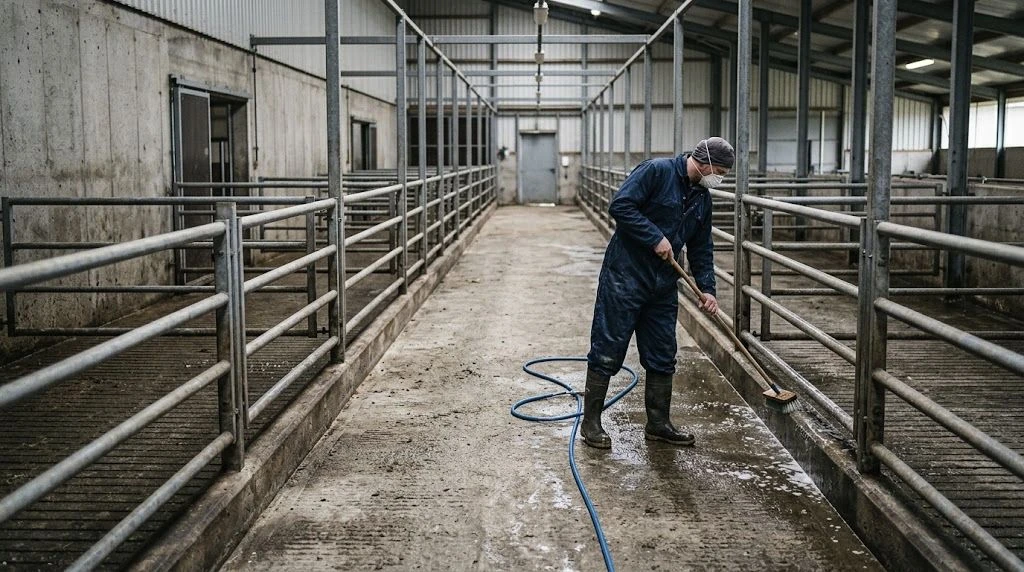
Surface disinfection works only after cleaning. Workers first remove animals according to the operational plan, scrape manure and bedding, remove loose soil, wash approved surfaces, manage runoff, and allow surfaces to dry where the procedure requires it. The pre-disinfection inspection identifies cracks, damaged coatings, trapped debris, or inaccessible areas. Applying more solution cannot correct a porous surface, broken seal, or remaining organic matter.
Which farm surfaces are in scope?
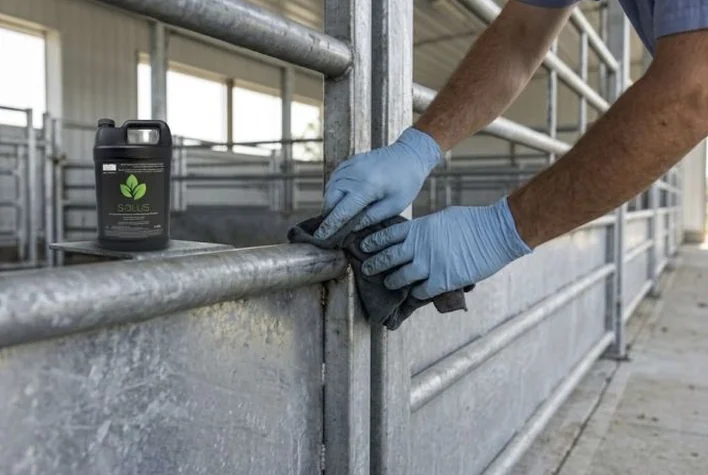
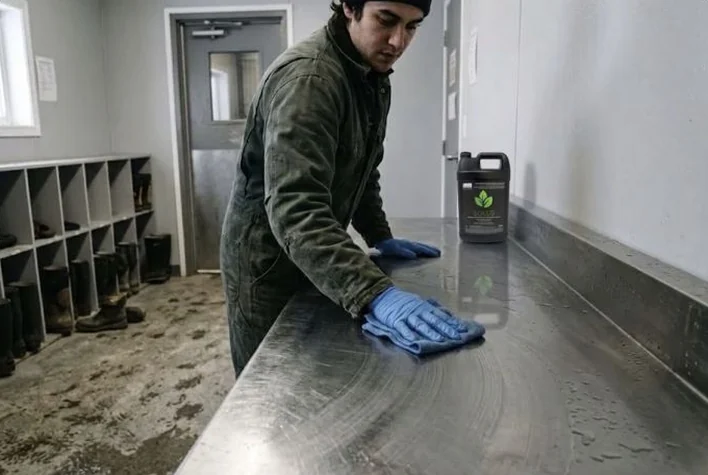
Eligible targets are hard, non-porous, cleanable facility surfaces covered by the current label. Depending on material and instructions, the list may include sealed gate panels, coated partitions, hard door surfaces, latches, washable loading-ramp rails, trailer interiors after cleaning, equipment frames, cart handles, control exteriors, anteroom benches, and hard surfaces at a designated wash station. Every item still needs material compatibility and a defined application method.
Zone and use matter as much as material. A sealed gate can be a facility surface; a nose tong, needle, halter, boot sole, feed bucket, water trough, milking component, or veterinary instrument may have animal, feed, water, or body contact that changes the regulatory and label decision. This article does not authorize those applications. A hard exterior does not automatically make every component or route in scope. For food-facing equipment, review food-contact surface requirements.
Create a surface register with a unique name, location, zone, material, soil type, cleaning method, disinfection method, contact time, applicable rinse, responsible role, and release check. Mark excluded items clearly. The register should change when a new group, trailer, pen configuration, robotic system, or shared tool changes farm movement. A short, precise register is safer than a long generic list that workers interpret differently.
What does the tested evidence show?
The table contains the full product-specific test set. The evidence must not be extended to an animal disease, farm pest, or unnamed environmental organism.
| Organism | ATCC | Protocol and laboratory | Contact time | Report |
|---|---|---|---|---|
| Staphylococcus aureus | 6538 | AOAC Use Dilution Method; Analytical Lab Group GLP | 10 minutes | A30442 |
| Salmonella enterica | 10708 | AOAC Use Dilution Method; Analytical Lab Group GLP | 10 minutes | A30442 |
| Pseudomonas aeruginosa | 15442 | AOAC Use Dilution Method; Analytical Lab Group GLP | 10 minutes | A30442 |
| Human Coronavirus 229E | VR-740 | Virucidal efficacy on inanimate surfaces; Analytical Lab Group GLP | 1 minute | A30618 |
| Influenza A H1N1 | VR-1469 | Virucidal efficacy on inanimate surfaces; Analytical Lab Group GLP | 1 minute | A31073 |
Data last verified: August 2026.
The AOAC Use Dilution Method is reported as pass or fail. The method does not support an invented percentage or log reduction. Salmonella enterica is relevant context for agricultural and food settings, but the result is not a herd-health claim. Influenza A H1N1 is a human influenza strain. No report supports bovine, swine, equine, ovine, caprine, avian, veterinary, biofilm, mould, spore, pest, or pathogen-specific biosecurity efficacy.
How does the Multi-Purpose Disinfectant fit a farm program?
Solus’s Multi-Purpose Disinfectant can fill the disinfection step for clean, hard, non-porous farm-facility surfaces within the Institutional and Industrial use areas. The current label concentration is 367 ppm free available chlorine. The product does not replace dry cleaning, washing, drying, repair, zoning, traffic control, veterinary decisions, or the farm’s broader biosecurity plan.
The SDS supports a lower-toxicity handling profile when used as directed. The solution has a pH of 5.0–7.0 and an ORP of +600 to +1200 mV (§9). Follow the PPE requirements on the current product label and SDS; eye protection is recommended where splashing is possible, and gloves suit prolonged or repeated contact or sensitive skin (§8). A task or site can still require additional PPE, ventilation, drainage control, or equipment isolation.
Define application operationally. Verify the correct product and concentration, fully wet the mapped surface, start the timer, monitor for drying, follow applicable rinse directions, and isolate the clean zone until release. Assign dedicated tools or a verified tool-transition process. A worker moving the same hose, brush, or boot from a dirty livestock route into a released area can defeat a technically correct application.
Where does the scope stop?
The scope stops at authorized hard, non-porous surfaces in an agricultural or industrial facility. Do not apply the product to cattle, calves, pigs, sheep, goats, horses, other animals, skin, wounds, udders, hooves, feed, bedding, litter, drinking water, water systems, veterinary instruments, or porous materials. Do not present the product as a treatment, veterinary disinfectant, herd-health intervention, or control for a named animal pathogen.
Biosecurity remains context. Solus’s Multi-Purpose Disinfectant does not become “biosecurity effective” because the farm includes surface disinfection in its biosecurity plan. If the farm needs a pathogen-specific animal-use, water-use, or pest-control claim, it must select an appropriately authorized or PMRA-registered product and follow that product’s label. A veterinarian, CFIA instruction, outbreak plan, or commodity program may impose additional measures.
Any surface that may contact food, drinking water, animals, or the body requires the current label’s applicable directions and potable-water rinse where required. When the surface register cannot resolve the route or target, stop. Do not infer permission from the farm setting, the material, or the authorization number alone.
How do you build a between-group cleaning routine?
Tie the routine to a production or movement trigger: a pen change, calf-group transfer, trailer return, loading event, equipment loan, isolation release, or scheduled zone reset. Remove the group and movable materials. Dry-clean manure, bedding, and loose debris. Wash approved surfaces from high to low, manage runoff away from animals and sensitive areas, dry as required, and inspect. Correct defects before the disinfection step.
Verify the product, 367 ppm label concentration, surface list, and application tools. Treat one zone at a time and keep the surface wet for the full label contact time. Reapply and restart the timer if drying occurs. Complete any required potable-water rinse. Allow drying and restrict movement until supervisor release. Only clean, verified equipment crosses into the finished zone.
For audit-ready records, compare HACCP sanitation documentation. The record should identify the prior and next group, zone, surface set, operator, cleaning result, concentration, contact time, rinse, drying, corrective action, and approver. Review recurring deviations alongside maintenance and movement records. A repeatedly dirty latch may need a redesigned route; a damaged coating may need repair; a shared trailer may need a dedicated wash sequence. Those operational corrections strengthen the program without attributing unsupported disease-control efficacy to the product.
Building a farm-facility surface routine? Review the Solus product range and confirm every target against the current label.
Frequently asked questions
Does this product provide livestock biosecurity efficacy?
No. Biosecurity describes the farm program and the reason surfaces are managed. Solus’s Multi-Purpose Disinfectant has evidence for five named laboratory organisms on inanimate surfaces. The product does not carry a livestock-disease, herd-health, veterinary, or pathogen-specific biosecurity efficacy claim.
Can the product be used directly on animals?
No. This article covers authorized hard, non-porous facility surfaces only. Do not apply the product to animals, skin, wounds, udders, hooves, feed, bedding, or drinking water. Select the appropriate authorized product and professional procedure for any animal-use need.
Can a farm use the product in water systems?
This article does not support that use. The product is not applied to drinking water. A hard component may qualify only when the label supports the surface and method, with potable-water rinsing where required. Water treatment and pathogen-specific applications need separately authorized products.
Why must manure and soil be removed first?
Organic debris blocks complete contact with the hard surface and can consume disinfectant chemistry. Workers scrape, wash, dry, and inspect before application. A remaining soil layer, porous surface, damaged coating, or inaccessible seam cannot be corrected by adding more product.
What efficacy evidence is available?
The Solus lab reports cover five organisms with ATCC identifiers, protocols, contact times, Analytical Lab Group GLP status, and report numbers. The reports do not establish animal-pathogen, veterinary, herd-health, biofilm, mould, or pest-control efficacy.
Final thoughts
Livestock biosecurity succeeds through boundaries, movement rules, cleaning, maintenance, records, and appropriate product selection. Solus’s Multi-Purpose Disinfectant can support one narrow step: label-led disinfection of clean, hard, non-porous farm-facility surfaces. The product is not applied to animals, feed, or water and does not carry an animal-health or biosecurity-efficacy claim.
See also
- Agriculture surface disinfection — sector context
- HOCl handling evidence — label and SDS context
- Solus documents — plain text; linked once above
- Solus product range — plain text; linked once in the CTA
Sources
- Canadian Food Inspection Agency, farm biosecurity planning.
- Canadian Food Inspection Agency, dairy farm biosecurity guide.
- Canadian Food Inspection Agency, beef farm biosecurity.
- Solus biocide market authorization no. 02557371 and current label.
- Solus SDS/FDS §§8, 9, 14, 15; preparation date July 29, 2026.
- Analytical Lab Group GLP reports A30442, A30618, and A31073.