
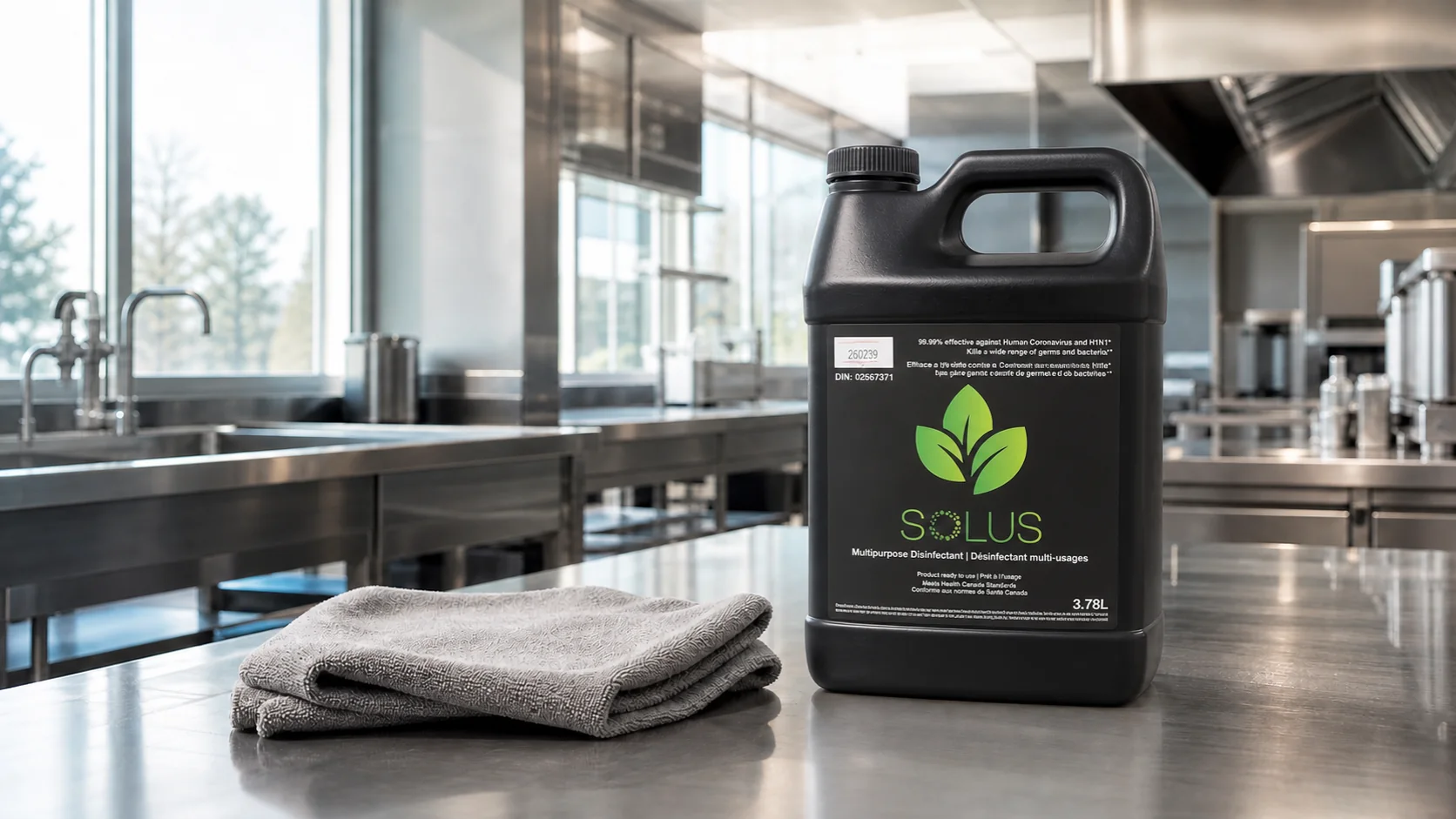
Hypochlorous acid (HOCl) and bleach are both chlorine disinfectants, but they do not work the same way. The Multi-Purpose Disinfectant has a near-neutral pH; follow the current label for rinsing and residue management. Canadian guidance uses about 1,000 ppm available chlorine for bleach surface disinfection (New Brunswick Health, 2020); bleach is corrosive and gives off irritant fumes. With either product, rinse food-contact surfaces with potable water afterward, per the label.
Key takeaways
- The comparison table below presents the complete organism-specific evidence, with every ATCC identifier, protocol, contact time, Analytical Lab Group GLP status and report number.
- Authorized for food-contact surfaces under Health Canada authorization (Food Premises). Per the label, rinse food-contact surfaces with potable water after use.
- Gentler on equipment than bleach thanks to its near-neutral pH 5.0–7.0 (SDS §9), though the label still says to avoid prolonged contact with metal. In the WHO EML submission, MSF describes HOCl generally as “non-toxic, non-corrosive.”
- Follow the current label for rinsing and residue management.
What is the difference between hypochlorous acid and bleach?
The difference is pH, and which form of chlorine is doing the work. HOCl is the neutral, highly active molecule, and it dominates at near-neutral pH 5.0–7.0 (Solus SDS §9). Household bleach is sodium hypochlorite (NaOCl), an alkaline solution around pH 11, where most of the chlorine sits as the much weaker hypochlorite ion (OCl⁻).
For this guide’s place within the wider topic, see our hypochlorous acid resource hub.
For terminology and production context, see electrolyzed water and HOCl explained.
Because Solus’s Multi-Purpose Disinfectant is made by electrolysis of a dilute salt solution (0.5% NaCl) and water (SDS §3), the chlorine is delivered mostly as HOCl rather than OCl⁻.
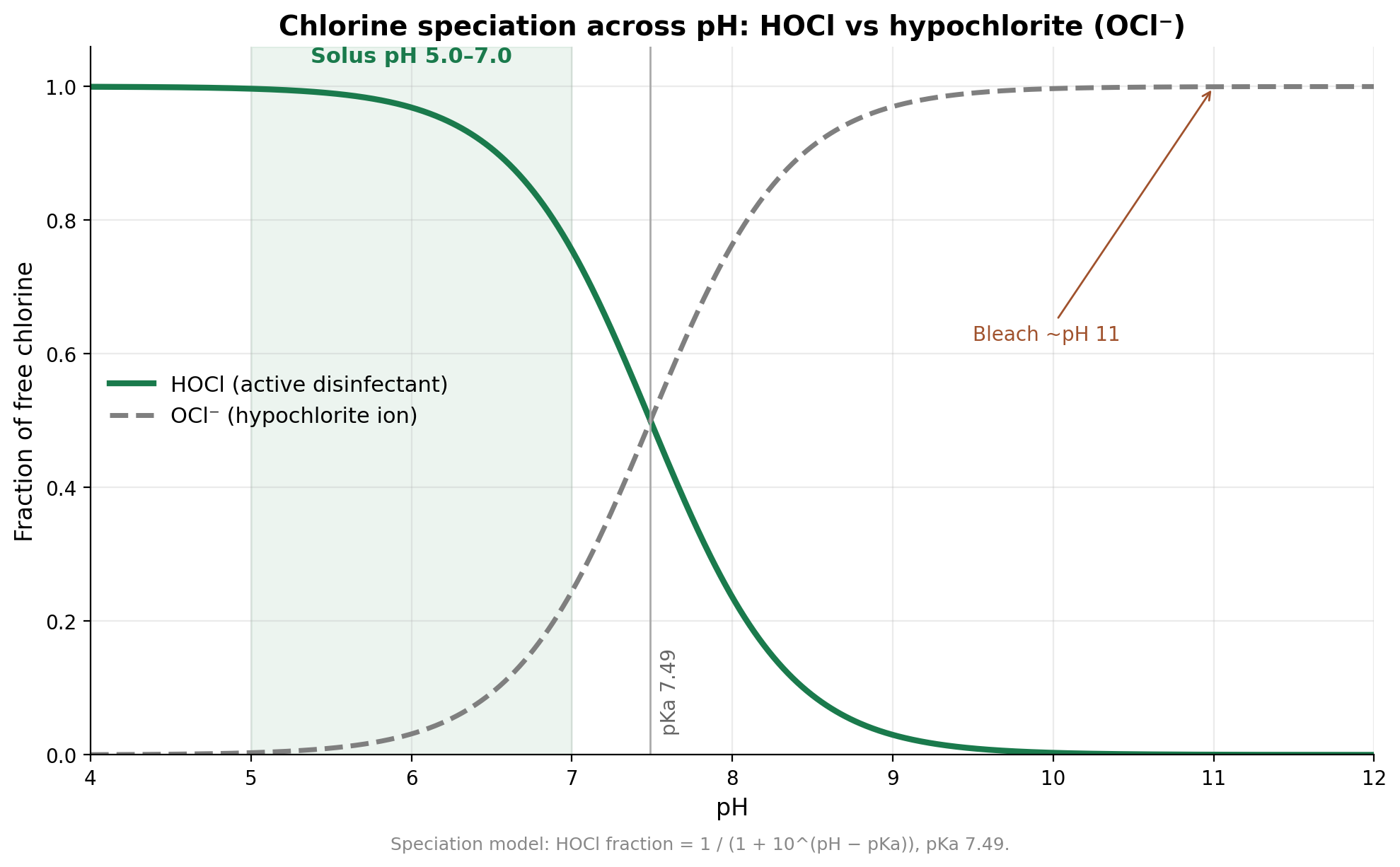
The WHO Essential Medicines List submission notes that national health authorities treat HOCl as distinct from hypochlorite because its “efficacy, safety, stability and environmental toxicology profiles are distinct in every particular.”
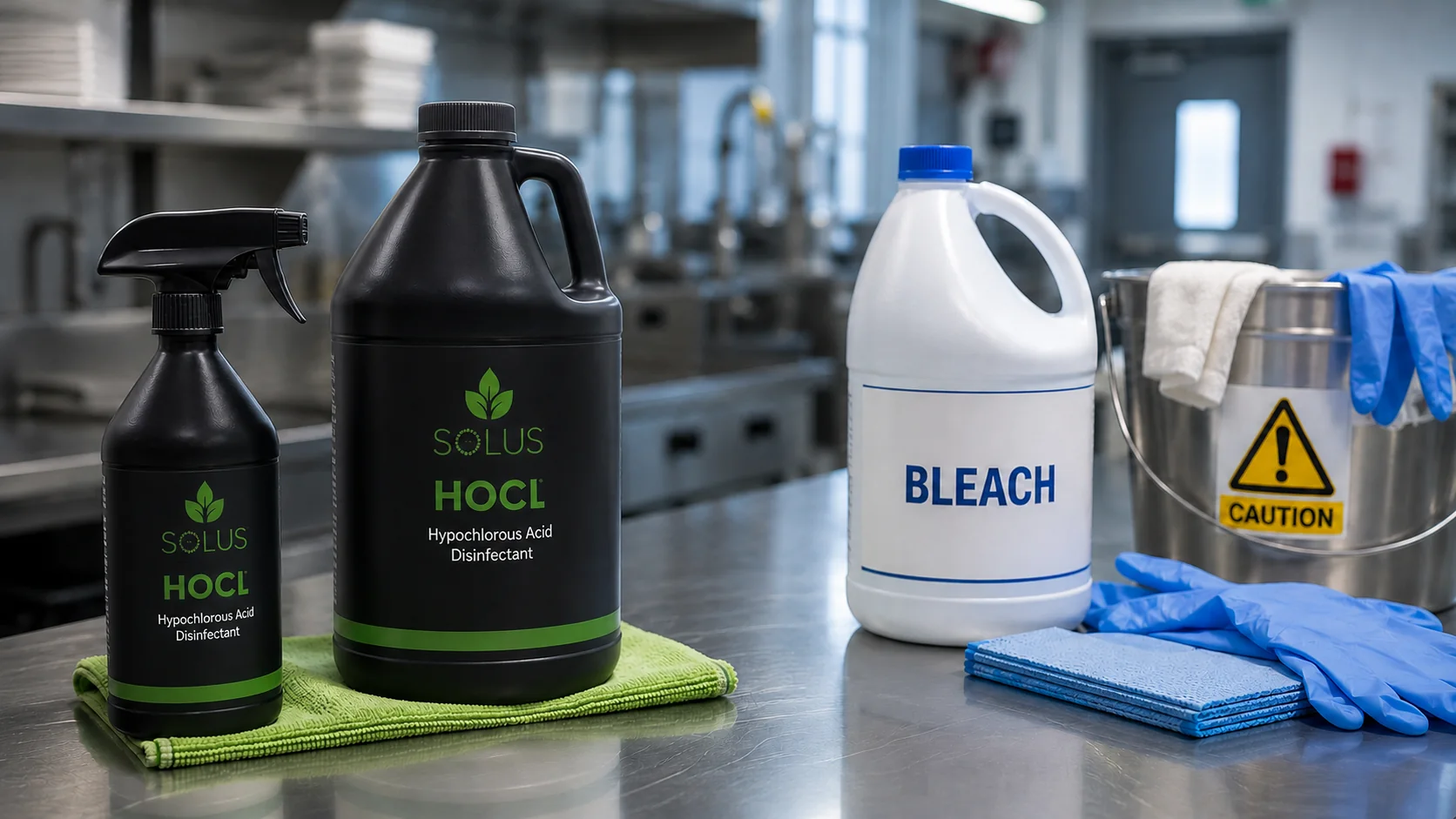
For a facility, pH changes the operating experience rather than the need to follow a label. Sodium hypochlorite bleach is normally alkaline, while the Multi-Purpose Disinfectant is specified at pH 5.0–7.0 (SDS §9). Staff still need a written procedure for both products: identify the compatible hard surface, remove visible soil, apply the product as directed, keep the surface wet for the stated contact time, and record any required rinse. The comparison therefore starts with chemistry but ends with a task-specific label check.
Consider a stainless worktable at the end of a shift. The supervisor first confirms which product is approved for that surface and whether food-contact rinsing applies. The worker clears debris and completes the cleaning step before disinfection. The product is then applied without mixing it with another chemical, and the wet period is timed from complete coverage—not from when the worker entered the room. If an edge dries early, that section is reapplied according to the label and its contact period restarts. The final record identifies the product, surface, start and finish time, rinse where directed, and corrective action.
How do the Multi-Purpose Disinfectant and bleach compare?
| Factor | Multi-Purpose Disinfectant | Bleach (NaOCl) |
|---|---|---|
| Active species / pH | HOCl, near-neutral pH 5.0–7.0 (SDS §9) | OCl⁻, alkaline (about pH 11) |
| Effective concentration | 367 ppm free available chlorine at the current label/SDS use concentration | about 1,000 ppm (0.1%) available chlorine for surface disinfection (New Brunswick Health, 2020) |
| Contact time (bacteria) | Staphylococcus aureus (ATCC 6538), Salmonella enterica (ATCC 10708), Pseudomonas aeruginosa (ATCC 15442); AOAC Use Dilution Method; 10 minutes; Analytical Lab Group, GLP; report A30442 | Follow the authorized bleach label; contact time varies by product, claim and soil condition. |
| Contact time (virus) | Human Coronavirus 229E (ATCC VR-740), Influenza A H1N1 (ATCC VR-1469); virucidal efficacy protocol for inanimate environmental surfaces; 1 minute; Analytical Lab Group, GLP; reports A30618 and A31073 | Follow the authorized bleach label; do not transfer the Multi-Purpose Disinfectant’s organism-specific GLP evidence to a bleach product. |
| Corrosive to equipment | Low: near-neutral pH, gentler than bleach; avoid prolonged metal contact (label) | Yes: corrosive to metals and equipment |
| Rinse required (food-contact surfaces) | Yes: rinse with potable water (label) | Yes, at disinfection strength; rinse with potable water |
| Fumes / PPE required | Follow the PPE requirements on the current product label and SDS; glasses if splashing, gloves if prolonged/repeated or sensitive skin (SDS §8). | Yes: releases irritant chlorine fumes; ventilate |
| Residue after use | Follow the current label for rinsing and residue management. | Chlorinated or salt residue; rinse to remove |
A sealed container of Solus’s Multi-Purpose Disinfectant also holds its strength for a year, unlike short-lived at-home HOCl that has to be mixed fresh. See our guide on how long hypochlorous acid lasts. For another disinfectant comparison, see HOCl vs quats for Canadian facilities.
Is HOCl safer to handle than bleach?
At its near-neutral pH (5.0–7.0), Solus’s Multi-Purpose Disinfectant is not regulated under WHMIS and is not classified as dangerous goods for transport in Canada. Follow the PPE requirements on the current product label and SDS; the SDS recommends eye protection where splashing is possible and gloves for prolonged or repeated contact or sensitive skin (SDS §8). Bleach, by comparison, is corrosive and gives off irritant chlorine fumes, so it needs ventilation and care.
For a broader class comparison, see our guide to choosing disinfectants in Canada.
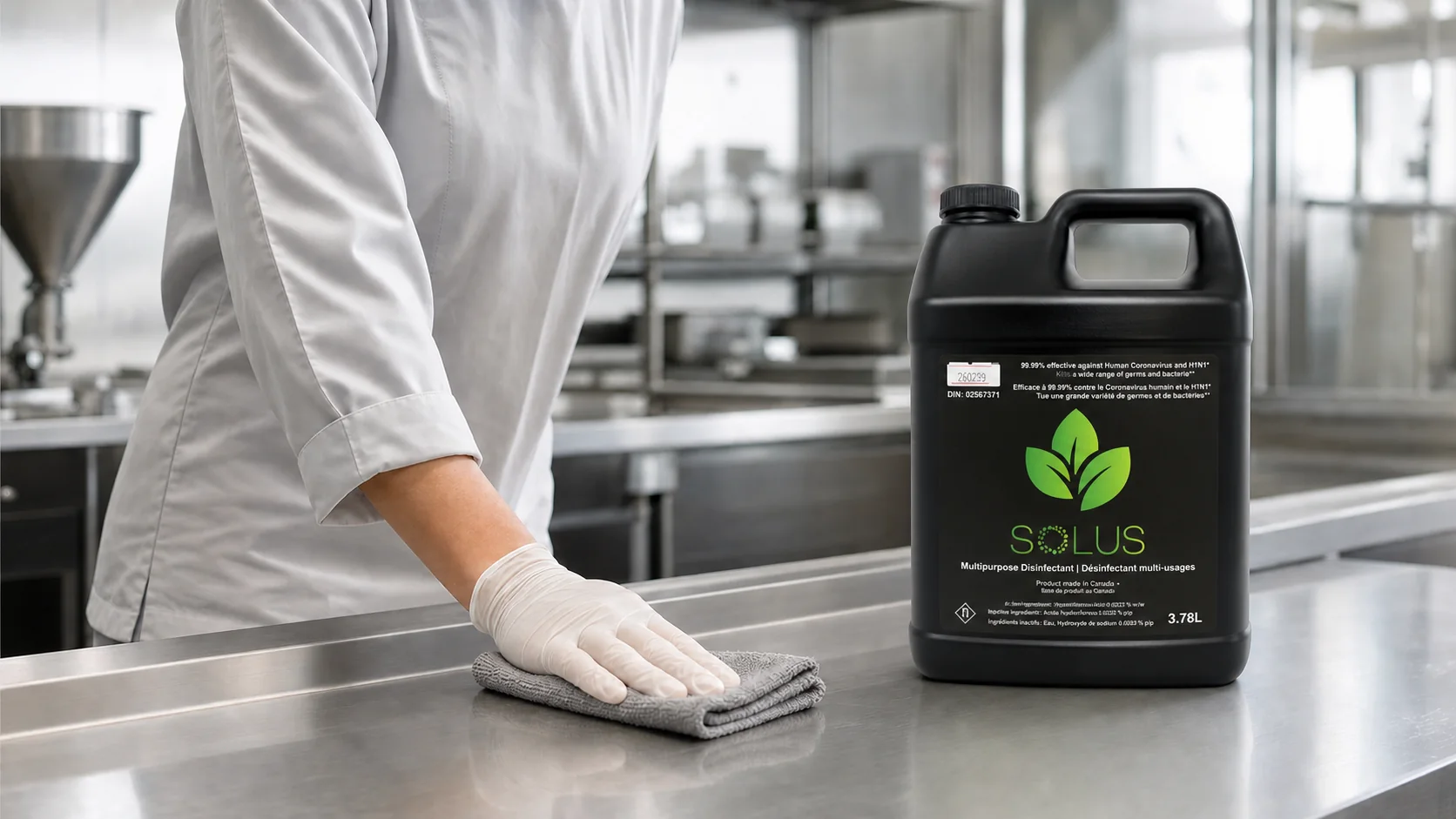
Handling decisions should be written around exposure points. Decanting, overhead application and work near the face create different splash potential from wiping a waist-height surface. For the Multi-Purpose Disinfectant, follow the PPE requirements on the current product label and SDS; the SDS recommends eye protection where splashing is possible and gloves for prolonged or repeated contact or sensitive skin (SDS §8). Bleach users must follow the bleach product’s own label and SDS rather than borrowing the Multi-Purpose Disinfectant instructions.
Ventilation and compatibility also belong in the pre-task check. A worker should never mix bleach with acids, ammonia or another cleaner, and should stop if an unknown residue is present. For either product, the procedure should name the application tool, the area that must remain wet, the action to take after a spill, and the person who approves a material-compatibility exception. This converts a general “safer to handle” comparison into observable controls that a supervisor can train and audit.
Can the Multi-Purpose Disinfectant be used on food-contact surfaces?
Yes, but only surfaces, not the food itself. Solus’s Multi-Purpose Disinfectant is authorized under Health Canada biocide market authorization no. 02557371 with DISINFECTANT (Food Premises) as an approved use, so it disinfects surfaces in food-handling environments. It is not approved for use on food, and the label says to rinse food-contact surfaces with potable water after use.
Frequently asked questions
Do I need to rinse food-contact surfaces after use?
Yes. Solus’s Multi-Purpose Disinfectant is authorized by Health Canada under biocide market authorization no. 02557371, with Food Premises as an approved use for disinfecting surfaces in food-handling environments. The current label says to rinse food-contact surfaces with potable water after applying it, so follow that step.
Does HOCl damage stainless steel?
HOCl is much gentler than bleach. At near-neutral pH 5.0–7.0 it is easy on most surfaces and equipment, though the label still says to avoid leaving it in prolonged contact with metal. Bleach (sodium hypochlorite), by comparison, pits and degrades metals over time. In the WHO EML submission, MSF describes HOCl generally as “non-toxic, non-corrosive.”
How fast does the Multi-Purpose Disinfectant work?
Use the complete organism-specific evidence in the comparison table rather than a universal speed claim. Each row keeps the tested organism with its ATCC identifier, protocol, contact time, Analytical Lab Group GLP status and report number. The result applies to the stated test conditions and should not be transferred to another product.
Is hypochlorous acid the same as bleach?
No. They are both chlorine-based, but HOCl is the neutral active molecule at pH 5.0–7.0, while bleach is sodium hypochlorite at a high pH (around 11) where the weaker hypochlorite ion takes over. Health authorities treat the two as genuinely different, not interchangeable.
Is the Multi-Purpose Disinfectant safe around people and animals?
Solus’s Multi-Purpose Disinfectant is not WHMIS-regulated. Follow the PPE requirements on the current product label and SDS; the SDS recommends eye protection where splashing is possible and gloves for prolonged or repeated contact or sensitive skin (SDS §8). Follow the label directions and keep it out of eyes and off skin.
Readers comparing handling should also review HOCl safety for surface disinfection, while storage and replacement planning is covered in the HOCl shelf-life guide.
Final thoughts
Bleach and HOCl each require product-specific review of the current label and SDS for PPE, ventilation, material compatibility and rinsing. Solus’s Multi-Purpose Disinfectant has a near-neutral pH and Health Canada biocide authorization for food-premises surfaces. Rinse food-contact surfaces with potable water after use, store the bottle sealed and out of light, and follow the label.
Ready to switch? Browse the Multi-Purpose Disinfectant range or review the certifications and lab reports behind these numbers.