
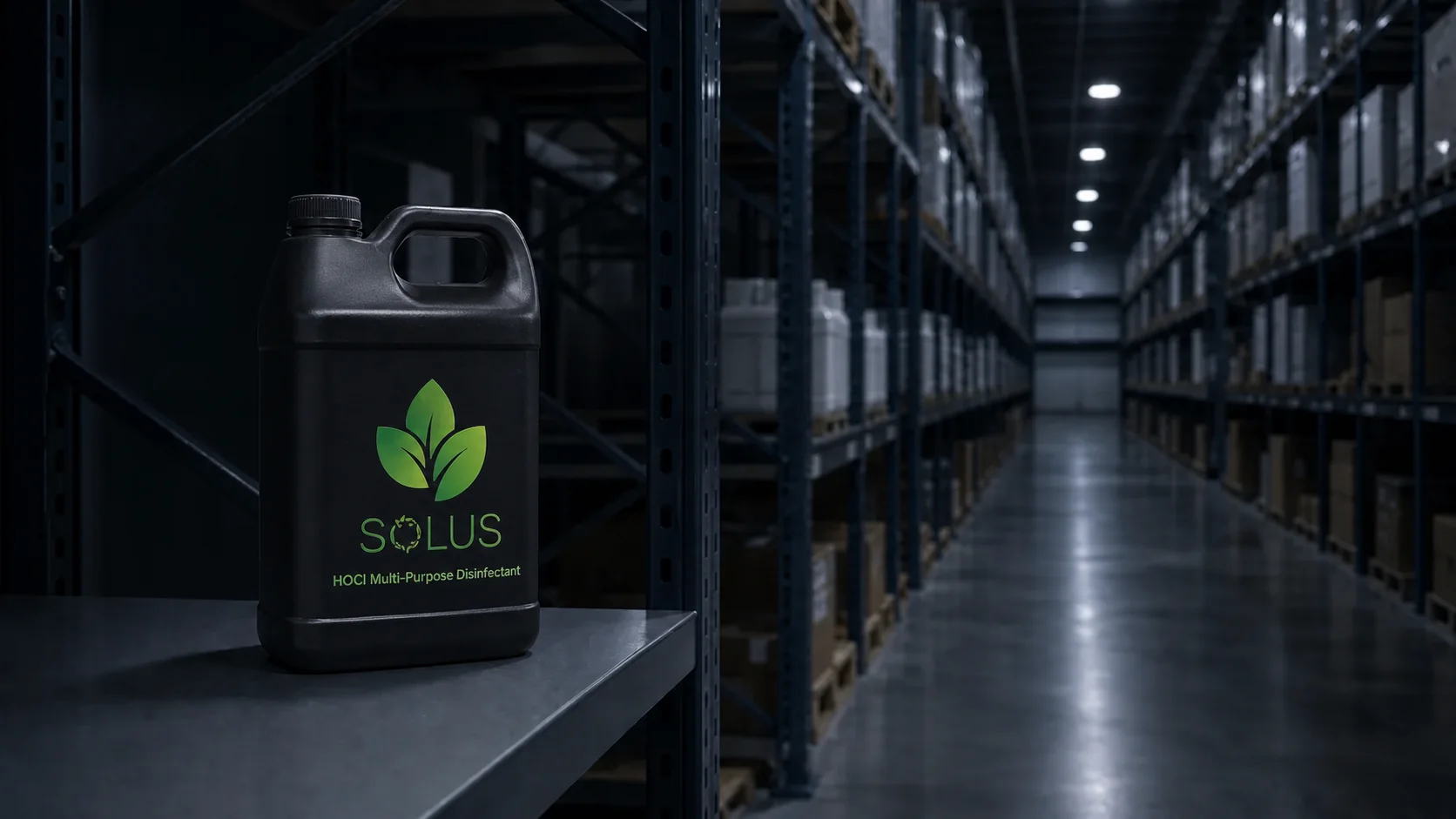
The Multi-Purpose Disinfectant stays good for 1 year from the manufacturing date on its Certificate of Analysis, as long as you keep it between 5 and 25°C, out of direct sunlight, in an opaque container. Many at-home HOCl products last nowhere near that long.
For this guide’s place within the wider topic, see our hypochlorous acid resource hub.
Key takeaways
- Solus’s Multi-Purpose Disinfectant has a 1-year shelf life from manufacture when stored at 5–25°C, out of direct sunlight and in an opaque container (Certificate of Analysis).
- The Solus SDS lists electrolysis of a 0.5% sodium chloride solution and water as the manufacturing method (SDS §3).
- The Multi-Purpose Disinfectant from Solus is near-neutral at pH 5.0–7.0 with an ORP of +600 to +1200 mV (SDS §9).
- Health Canada authorizes Solus’s Multi-Purpose Disinfectant as a biocide under market authorization no. 02557371; its Certificate of Analysis supplies the separate 1-year shelf-life specification.
“People think all hypochlorous acid is the same and that it all lasts about as long. It doesn’t. How it’s made, tested, bottled and stored makes a big difference to how long it keeps.”
Philippe Mathys, Solus
How long does hypochlorous acid last?
The Multi-Purpose Disinfectant is good for 1 year from its manufacturing date, per its Certificate of Analysis, stored at 5–25°C, out of direct sunlight, in opaque containers. How long any HOCl lasts depends mostly on how it was made and how it is stored. A pure, electrolysis-made solution with high oxidation-reduction potential (ORP) keeps its strength much longer than solutions made other ways, some of which fade within days to weeks.
Why does HOCl break down, and why does the Multi-Purpose Disinfectant last longer?
Over time HOCl reverts toward less active chlorine species, and heat, light, air, and impurities all speed that up. The WHO Essential Medicines List submission notes that HOCl made by electrolysis, from pure preparations with high ORP, has a longer shelf life, while HOCl made by other processes “offer only very short shelf life and need to be used as soon as possible after production.”
The Multi-Purpose Disinfectant from Solus fits that profile: electrolysis-made from a dilute salt solution (SDS §3), near-neutral at pH 5.0–7.0, and ORP +600 to +1200 mV (SDS §9). The cool, dark, opaque storage on the Certificate of Analysis is what protects the potency. Here is what shortens an HOCl solution’s life versus what extends it:
| Factor | Shortens HOCl life | Extends HOCl life | Where the Multi-Purpose Disinfectant sits |
|---|---|---|---|
| How it’s made | Non-electrolytic or impure prep; “very short shelf life” (WHO EML submission) | Electrolysis of a pure, dilute salt solution | Electrolysis-made (SDS §3) |
| pH | Unstable, far from neutral | Near-neutral, stable HOCl | pH 5.0–7.0 (SDS §9) |
| ORP | Low | High oxidation-reduction potential | +600 to +1200 mV (SDS §9) |
| Light | UV or visible light degrades HOCl | Dark storage, opaque bottle | Opaque container |
| Temperature | Heat accelerates breakdown | Cool storage | 5–25°C |
Data last verified: August 2026.
How should I store Solus’s Multi-Purpose Disinfectant?
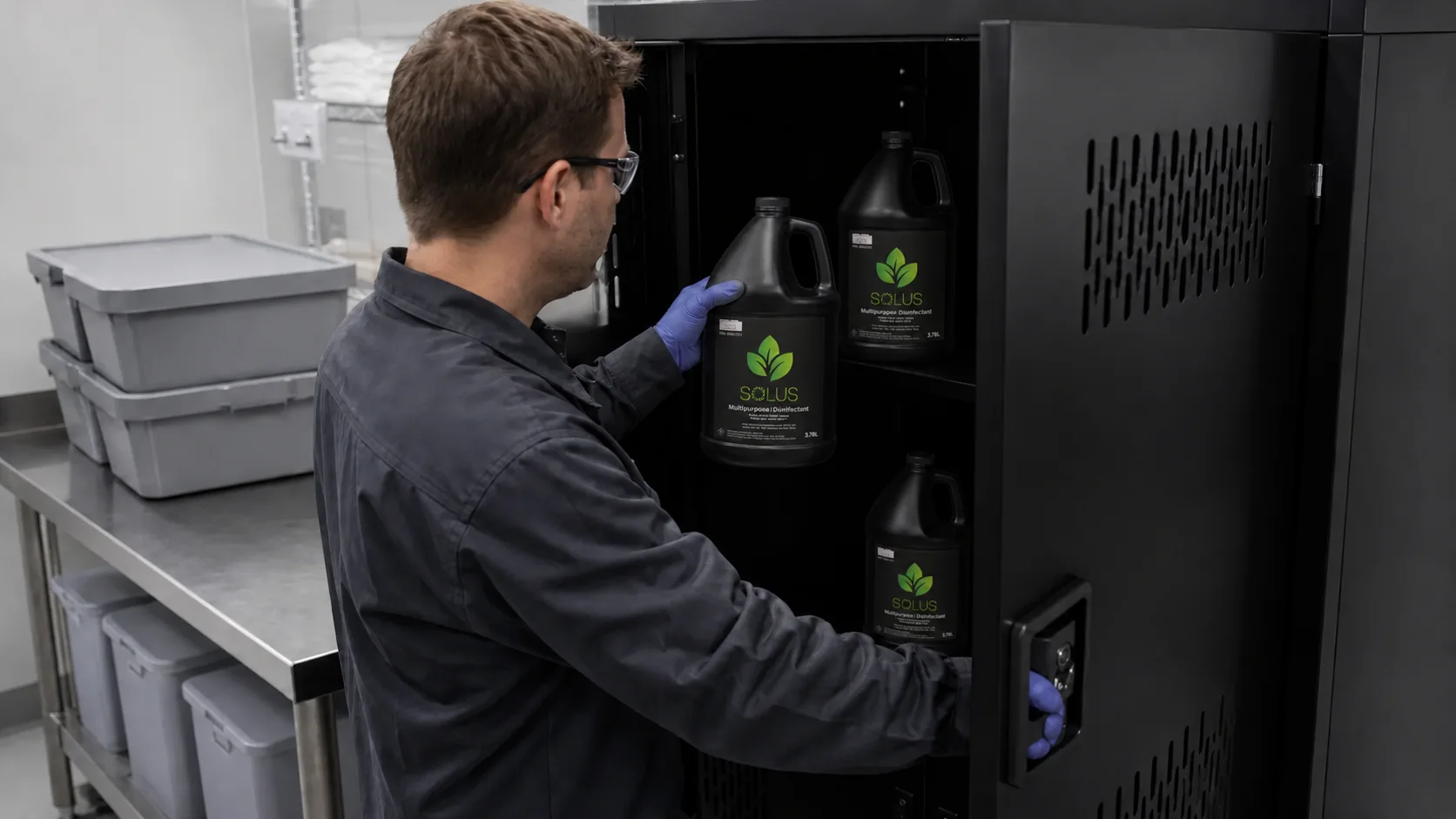
Store it between 5 and 25°C, out of direct sunlight, in its opaque bottle, and use it within a year of the manufacturing date. Those conditions are what protect the potency; the table above shows why each one matters.
Each stressor acts differently. Light supplies energy that accelerates chlorine-species changes; higher temperature speeds chemical reactions; contamination introduces additional material that can consume available chlorine; and repeated opening increases opportunities for exposure or transfer errors. These mechanisms are why a shelf-life statement must include both time and conditions. “One year” is not a promise for a bottle left open, stored in sunlight or moved into an unsuitable container—it is the COA specification for product kept within the stated conditions.
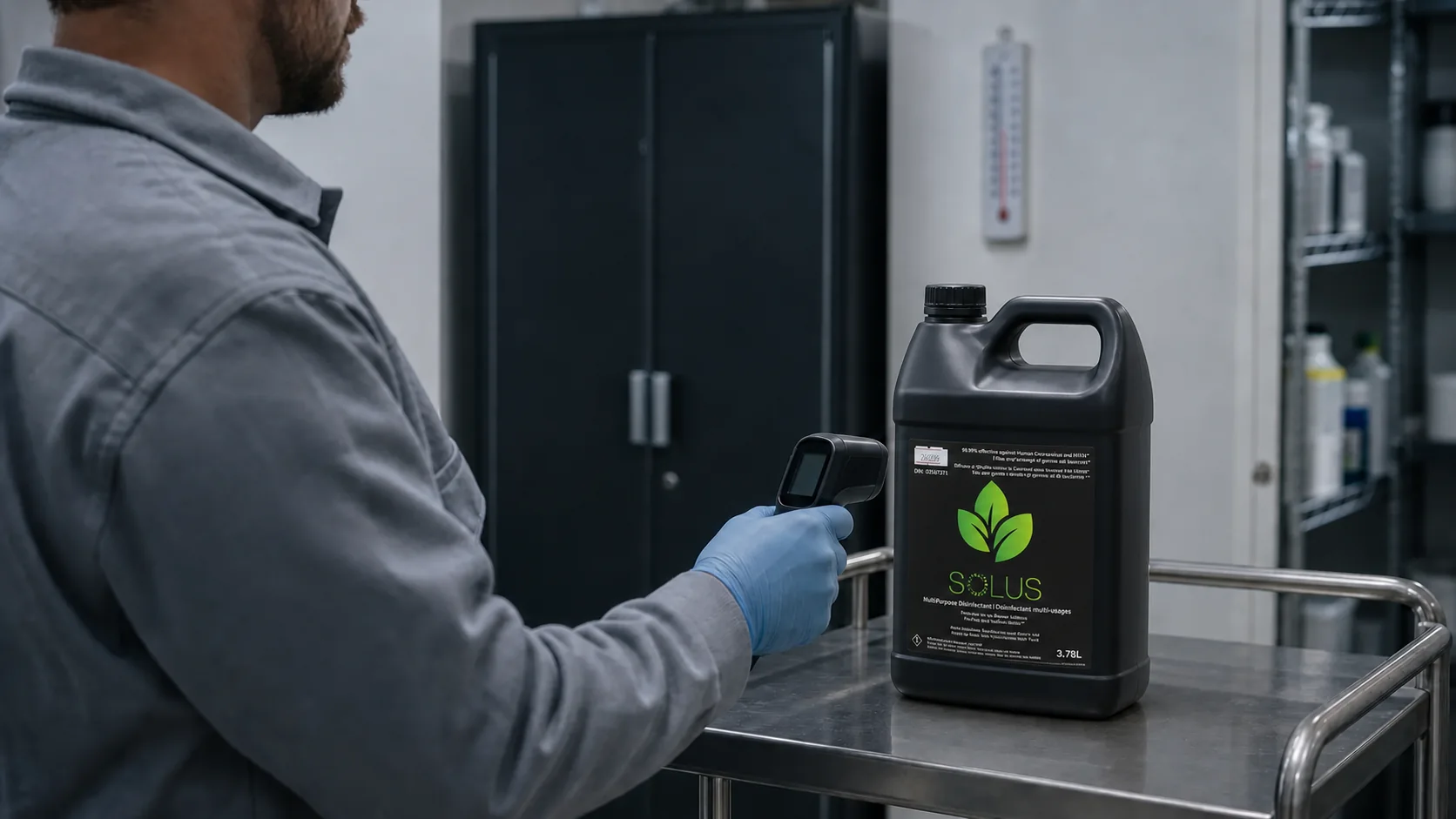
A storage check should be specific enough that another employee can repeat it. Record the manufacturing date, the one-year expiry point from the Certificate of Analysis, the container format, the storage location and any exception. During a monthly inventory walk, verify that the bottle remains opaque, closed and away from direct sunlight, then compare the room reading with the 5–25°C COA range. If a container has been left near a window, heat source or loading door, isolate it and follow the facility’s product-assessment procedure instead of resetting the date or assuming appearance proves potency.
Stock rotation matters as much as room temperature. Mark opened and unopened containers according to the facility procedure, keep older in-spec stock at the front, and avoid topping up one container from another. Transferring the solution into a clear or unlabelled bottle removes the light protection and traceability that support the shelf-life decision. A receiving record should connect each container to its manufacturing date, while the use log helps staff finish an older container before a newer one without changing the COA-based expiry.
Do I need to make HOCl fresh?
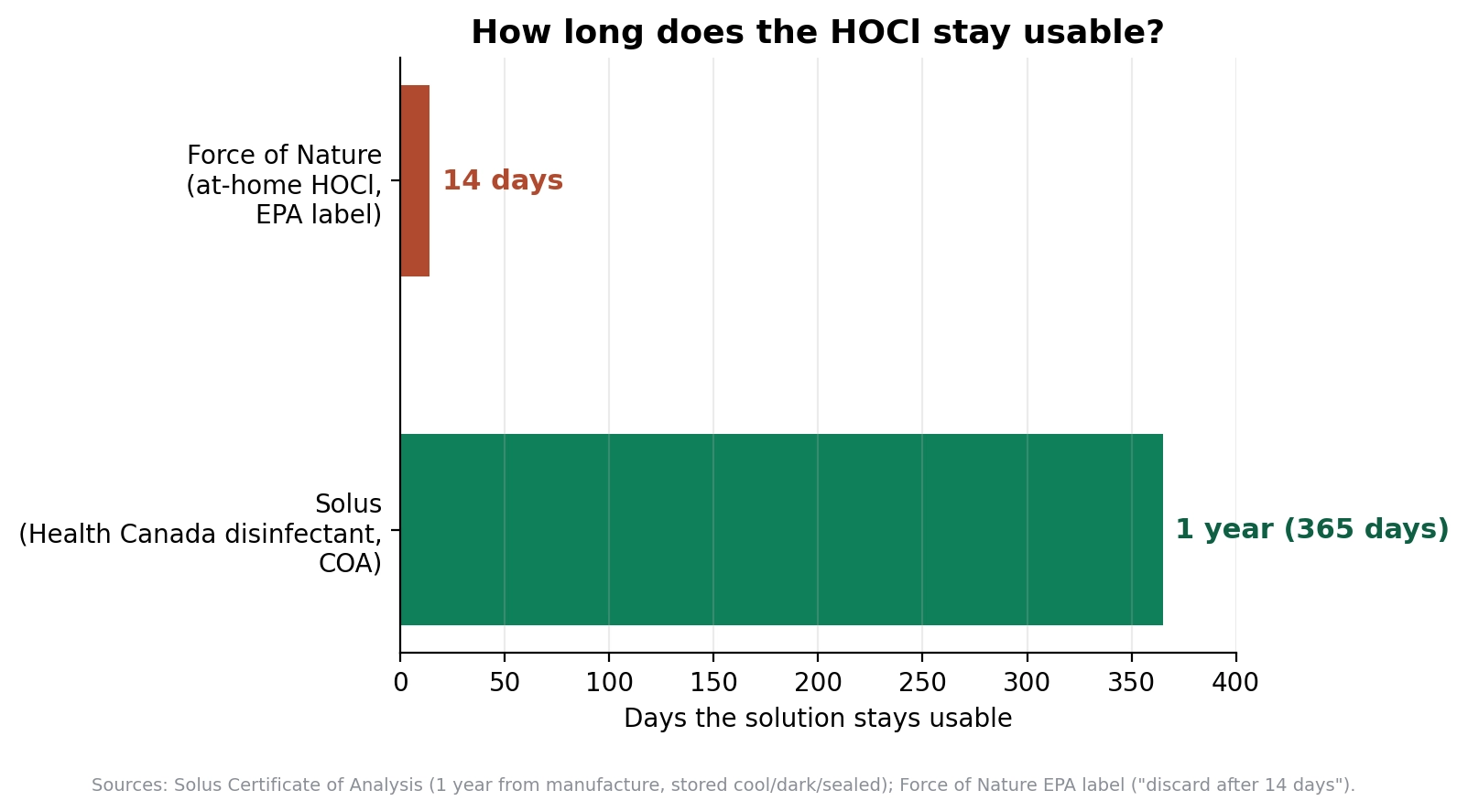
No. Some at-home HOCl generators are designed for small, fresh batches because their solutions have a short usable life. Solus’s Multi-Purpose Disinfectant is different: it is supplied ready to use, is authorized by Health Canada as a biocide (market authorization no. 02557371), and has a Certificate of Analysis valid for 1 year from manufacture when stored at 5–25°C, out of direct sunlight and in an opaque container.
A facility can turn that distinction into a simple receiving-and-use workflow. At delivery, staff record the manufacturing date and calculate the COA-based end date without changing it when the container is opened. Before use, the operator checks the label, container condition and storage history, then returns the closed bottle to the same controlled area. If the date or storage history cannot be verified, the container is held for review rather than treated as a newly prepared batch. This preserves both traceability and the conditions behind the one-year specification.
Fresh generation and ready-to-use supply also create different quality-control responsibilities. A freshly generated solution requires the operator to control the generator, inputs, batch identification and any concentration verification required by that system. A ready-to-use product shifts those tasks to receiving, storage, inventory rotation and label compliance. Neither approach eliminates documentation; the records simply follow different control points.
Frequently asked questions
Does hypochlorous acid expire?
Yes. Solus’s Multi-Purpose Disinfectant has a 1-year shelf life from manufacture when stored at 5–25°C, out of direct sunlight and in an opaque container. The date comes from its Certificate of Analysis; review the Solus technical documents for the proof behind the shelf-life specification.
Why do some HOCl products have a shorter shelf life?
Manufacturing method and storage conditions matter. The WHO EML submission describes pure, electrolysis-made HOCl products as having extended shelf life, while other processes can produce short-lived solutions. Solus’s Multi-Purpose Disinfectant is made by electrolysis of a 0.5% sodium chloride solution and water (SDS §3); see the Solus technical documents.
How should I store Solus’s Multi-Purpose Disinfectant?
Store Solus’s Multi-Purpose Disinfectant between 5 and 25°C, out of direct sunlight and in its original opaque container. These are the conditions specified for the 1-year shelf life from manufacture. Keep the container closed between uses and avoid transferring the product into clear containers; browse the Multi-Purpose Disinfectant range for available formats.
Does the Multi-Purpose Disinfectant need to be mixed fresh like some home HOCl devices?
No. Solus’s Multi-Purpose Disinfectant is supplied ready to use and has a Certificate of Analysis valid for 1 year from manufacture when stored at 5–25°C, out of direct sunlight and in its opaque container. Facilities do not need to generate a fresh batch each day; see the ready-to-use Solus product range.
Storage planning should sit alongside HOCl safety and handling guidance, the HOCl-versus-quats comparison, and HACCP sanitation documentation.
Final thoughts
Shelf life is where an authorized, electrolysis-made HOCl pulls ahead of the at-home versions. Stored at 5–25°C, out of direct sunlight and in its opaque container, Solus’s Multi-Purpose Disinfectant has a 1-year shelf life from the manufacturing date, so there is no daily mixing and no guessing whether the solution is still working. Keep it between 5 and 25°C, out of the light, and use it within the year on the Certificate of Analysis.
Browse the Multi-Purpose Disinfectant range or check the Certificate of Analysis and other documents behind the one-year claim.
See also
- Solus HOCl product range
- Certificate of Analysis and other documents
- Common questions about Solus HOCl
Related
- HOCl vs Bleach: How They Compare for Canadian Facilities