
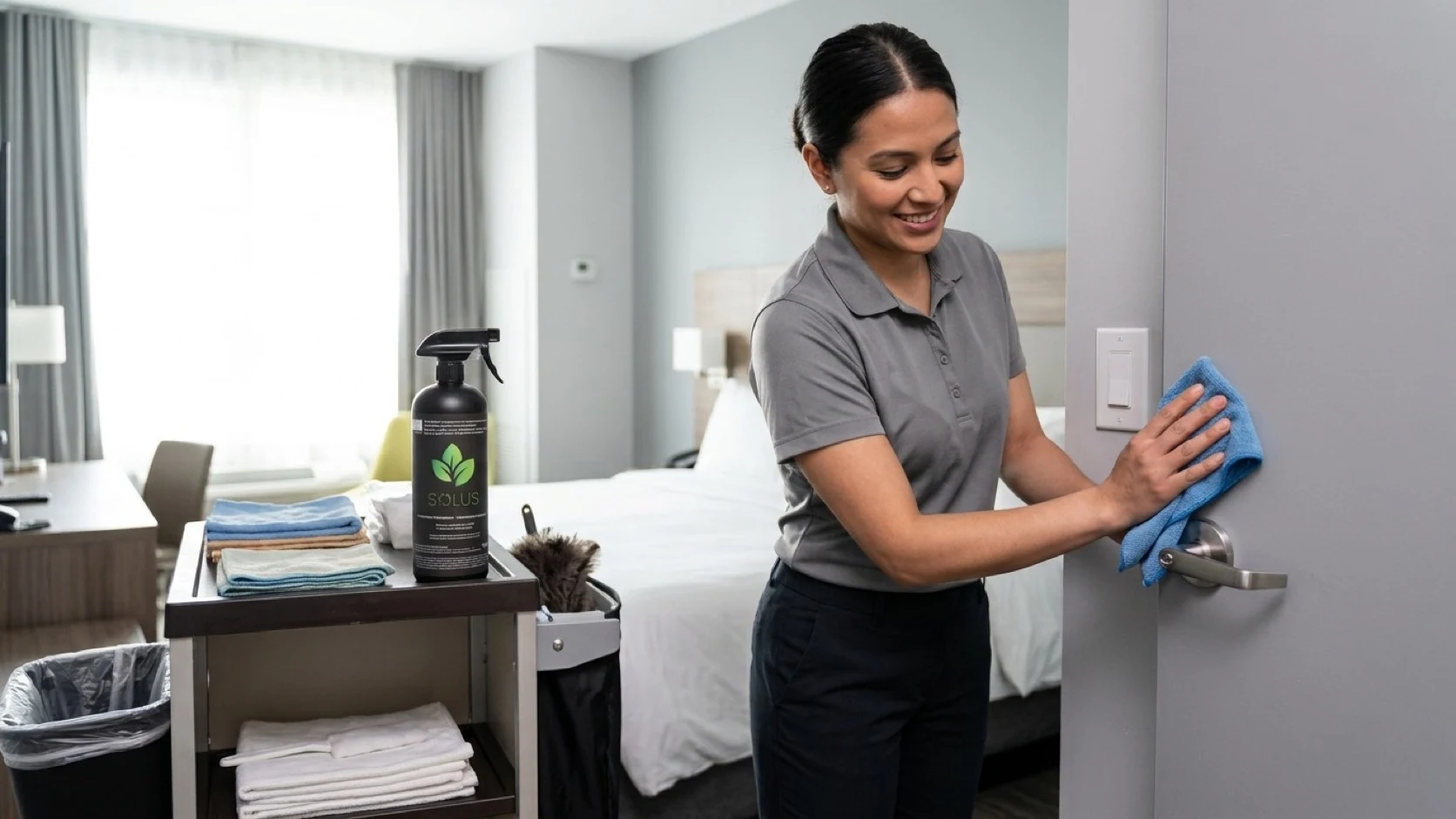
Direct answer
Hotel hygiene works best as a risk- and traffic-based routine: clean soil first, identify high-touch points, use a hard-surface disinfectant according to its label, and document the room-turnover and common-area checks. Local guidance and the property’s SOP should set frequency. Do not treat this article as a hotel regulation or a substitute for the product label.
For an overview, see our hypochlorous acid (HOCl) guide.
Key takeaways
- Guest-room controls, handles, remotes, faucets, elevator buttons, payment terminals, and rails are high-touch points that deserve a defined process.
- Room turnover, stayover service, occupancy, visible soil, spills, and event traffic can change the required frequency; write the decision into the housekeeping SOP.
- The Multi-Purpose Disinfectant’s current label concentration is 367 ppm free available chlorine. Use the current label and FDS/SDS when documenting concentration.
- The complete efficacy table below pairs every organism with an ATCC number, protocol, contact time, and report number.
- Use the label and FDS/SDS for handling. Avoid absolute product-safety or toxicology language; state only the precautions and instructions supported by the current panel.
On this page
- Why do high-touch points matter?
- Room-turnover surface checklist
- How should common areas be scheduled?
- Evidence a facilities team documents
- Choosing a hotel disinfectant
- Frequently asked questions
In hospitality the win is a repeatable surface routine guests never notice — the right hard surface, the label contact time, and a record housekeeping can hand to an auditor.
— Philippe Mathys, Solus
Why do high-touch points matter?
The Canadian Centre for Occupational Health and Safety hotel guidance recommends regular cleaning and disinfection with attention to high-touch objects. A property-specific list could instead track a business-centre keyboard, guest-laundry controls, a public telephone handset, and a bottle-filling button. This is a practical housekeeping principle, not a national hotel-frequency law; the property adapts it to occupancy, risk, visible soil, and local direction.
Which surfaces belong on a room-turnover checklist?
| Zone | High-touch examples | Frequency decision |
|---|---|---|
| Guest room | Remote, switches, thermostat, phone, door handles, desk, faucets | Every turnover or as the property’s risk plan requires |
| Bathroom | Faucet, flush handle, dispensers, door hardware, counter | Turnover plus visible soil/spill response |
| Common areas | Elevator buttons, rails, front desk, POS terminals, key-card points | Traffic- and event-based schedule |
| Low-touch/general | Floors, walls, ceilings, windowsills | Routine cleaning and spill response |
Data last verified: August 2026 from CCOHS and Public Health Ontario guidance; hotel management must confirm the local schedule.
How should staff handle a room turnover?
Start with a checklist that separates soil removal from disinfection. Remove waste and visible soil, clean the surface with the approved method, apply a product authorized for the intended hard surface, keep it wet for the label contact time, and complete the room reset. When occupancy or a spill changes the risk, the supervisor should record the extra action rather than silently changing the standard.
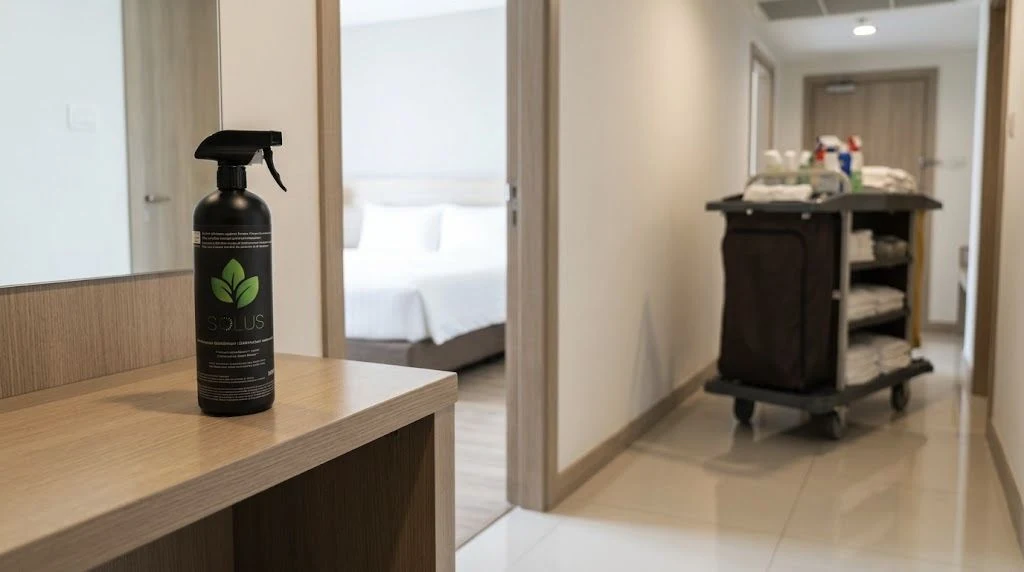
The picture slot is a reminder that the checklist should name the actual touchpoints. It should not imply that one product or one frequency fits every material, room, or property.
Make the checklist auditable without turning it into paperwork for its own sake. Record the room number, date and time, employee initials, surfaces completed, product used, label contact time, and any exception or corrective action. If a surface material is not covered by the procedure, stop and confirm compatibility instead of improvising. A supervisor can then sample completed rooms against the same checklist and coach a missed step before the room returns to service.
Handle guest-room touchpoints by material and use, not only by touch frequency. List the safe keypad, bedside-lamp control, curtain wand, closet pull, and minibar handle separately so “room complete” does not hide a missed surface. Electronics and coated controls require the application method and compatibility check specified by the property and current label; staff should not spray into openings. Where a surface or object may contact food, drinking water, an infant or toddler, an animal, or the body, the checklist should prompt a label review and the potable-water rinse wherever the label directs or recommends it. A bedside feeding surface, reusable cup area, pet-bowl location, or toddler touchpoint may therefore need a different finish from a door handle. The room stays open until required rinse and exception fields are complete.
How should common areas be scheduled?
Common areas change faster than an empty room. Elevators, rails, lobby counters, payment terminals, public washrooms, fitness equipment, and vending controls need a schedule tied to traffic and use. CCOHS recommends focusing on high-touch surfaces and cleaning regularly; Public Health Ontario’s environmental-cleaning guidance explains the high-touch/low-touch distinction in health-care settings, but it is not a hotel regulation.
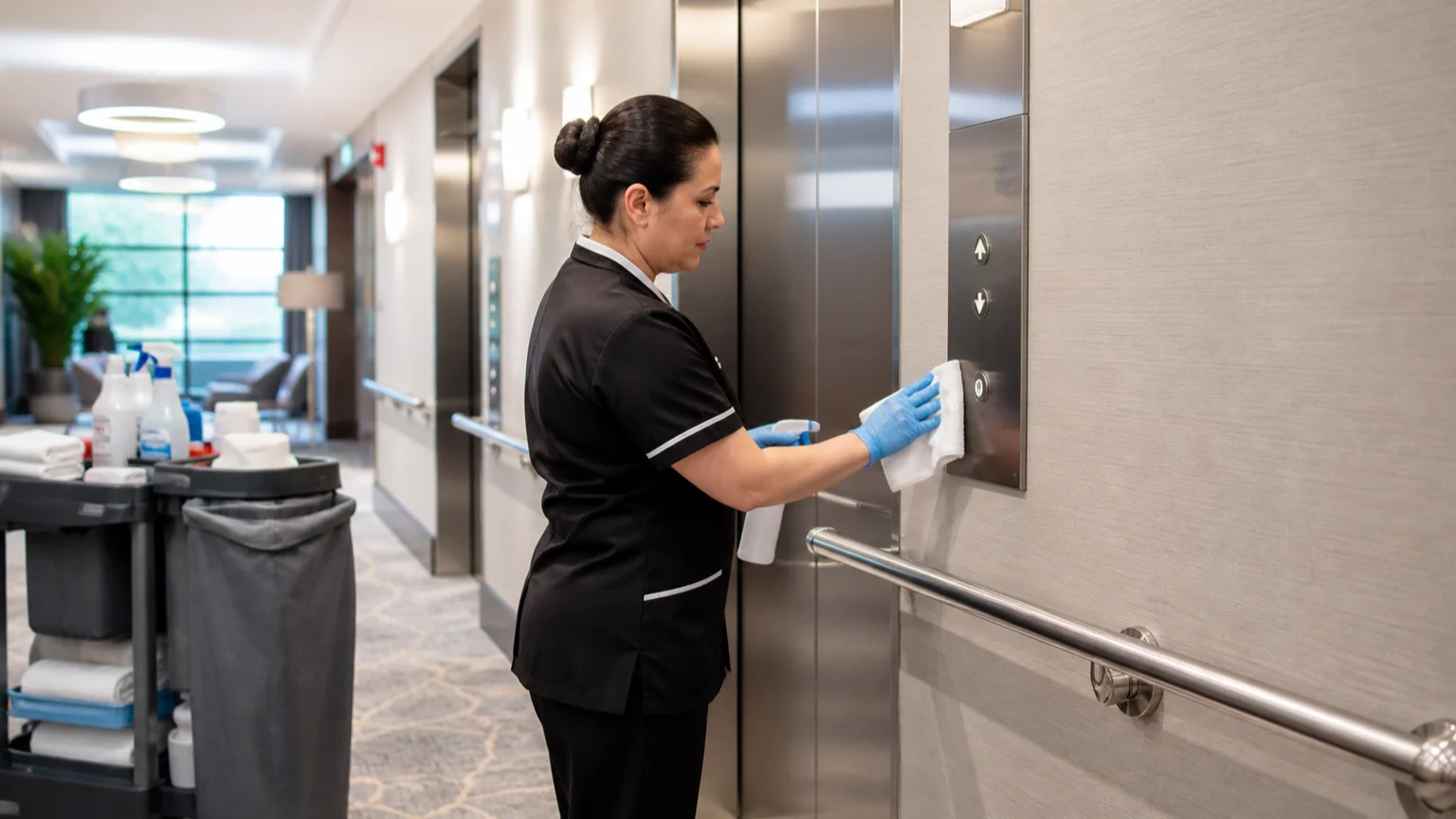
For hotels, use the local public-health direction, property SOP, occupancy, event calendar, and visible-soil response to set the interval. Avoid copying a health-care or COVID-era schedule into a hotel policy without checking that it applies.
A practical plan uses three triggers instead of the word “frequently.” Time-based triggers set routine checkpoints during a shift. Occupancy-based triggers add a pass after a check-in wave, meeting break, or other predictable surge. Event-based triggers respond to a spill, visible soil, or a reported concern. The log should show which trigger applied, the touchpoint or zone completed, and whether a corrective pass was needed. That gives managers a schedule they can adjust when traffic changes without pretending that every lobby, elevator, or fitness room carries the same risk.
Each trigger needs an operational example. A time-based checkpoint might assign elevator buttons and the main entrance push plate at opening, then public-washroom touchpoints midway through the evening shift. An occupancy trigger could add a lobby and elevator pass after a tour group completes check-in, or repeat selected conference-floor touchpoints after a scheduled meeting break. An event trigger starts when staff see a spilled drink at the reception counter, visible soil on a handrail, or a guest reports a specific concern; the affected point is addressed without waiting for the next routine round. The supervisor then checks the completed task against the property’s occupancy and event calendar.
A checkout surge can trigger an occupancy pass on luggage-cart grips, revolving-door push bars, lobby chair arms, and the parcel shelf after departures. A conference turnover combines time and event triggers: lectern controls, registration clipboards, partition pulls, and the coat-check counter are treated between groups; spills are handled immediately. After gym or pool peaks, staff address treadmill rails, locker latches, towel-bin lids, and the access-gate push plate without treating pool-water management as part of this surface procedure. Breakfast creates a timed handoff: staff address high-chair backs, juice-dispenser levers, tray-return grips, and the buffet-guard frame; food-contact equipment stays under its separate food-service procedure and label-led rinse instructions. Each task records its trigger and responsible team.
What evidence can a facilities team document?
The following is the complete Multi-Purpose Disinfectant efficacy reference for this product. It is included so no paragraph needs to make a partial efficacy statement.
| Organism | ATCC | Protocol | Contact time | Report |
|---|---|---|---|---|
| Staphylococcus aureus | ATCC 6538 | AOAC Use Dilution Method; Analytical Lab Group GLP | 10 minutes | A30442 |
| Salmonella enterica | ATCC 10708 | AOAC Use Dilution Method; Analytical Lab Group GLP | 10 minutes | A30442 |
| Pseudomonas aeruginosa | ATCC 15442 | AOAC Use Dilution Method; Analytical Lab Group GLP | 10 minutes | A30442 |
| Human Coronavirus 229E | ATCC VR-740 | Virucidal efficacy for inanimate environmental surfaces; Analytical Lab Group GLP | 1 minute | A30618 |
| Influenza A (H1N1) | ATCC VR-1469 | Virucidal efficacy for inanimate environmental surfaces; Analytical Lab Group GLP | 1 minute | A31073 |
The Solus documents page is the evidence hub for the biocide authorization, FDS/SDS, and reports. The table does not authorize a use outside the product label and does not convert a hotel setting into a medical-device or high-level-disinfection claim.
Does the biocide market authorization alone establish hotel use?
No. The use-area category under biocide market authorization no. 02557371 should not be treated as a standalone authorization for every hotel task. A hotel may use the Multi-Purpose Disinfectant only for hard, non-porous surfaces, methods, contact times, and premises covered by the current label. Describe hotel hygiene as an operational context; do not claim that “hotel” or “hospitality” is itself a named authorized use, and do not extend the label to textiles, electronics, occupied-room spraying, sterilization, or high-level disinfection.
The authorization number identifies the authorized product; it does not replace the directions and limits on the label. The label determines the use area, surface type, application method, contact time, precautions, and any rinse instruction. A hard, non-porous bathroom counter may fit an authorized surface description, while upholstered seating, bedding, unfinished wood, or a touchscreen may require a different method or may fall outside that use. Facilities staff must map each hotel task to the current label before adding it to the SOP; the authorization number alone cannot extend use to fabrics, room fogging, electronics, or every guest-room surface.
How should a hotel choose a disinfectant?
Review the current label, FDS/SDS, authorized surface, application method, wet contact time, and staff-handling directions. The Solus product range and Solus documents provide internal references. The article should not promise that a product is harmless or appropriate for every occupied space; the property must match the product to the task and follow the label.
Frequently asked questions
What counts as a high-touch hotel surface?
Examples include remotes, switches, thermostats, phones, handles, faucets, elevator buttons, rails, front-desk counters, payment terminals, and public-washroom fixtures. Build the property’s list from actual traffic patterns and room design, then document which staff role checks each zone. Review the list after renovations, events, or repeated complaints so it stays tied to actual use.
How often should guest rooms be disinfected?
Use the property’s risk-based SOP. Room turnover, stayover service, occupancy, visible soil, spills, events, and local guidance can change the interval. This article does not set a universal daily rule or treat health-care guidance as hotel law. Record the chosen schedule and the trigger for an extra pass.
Can a hotel use one product on every surface?
No. Match the product label to the hard, non-porous surface, material, application method, and intended use. Check metal, electronics, fabrics, and other sensitive materials separately. A hotel’s housekeeping SOP should identify exceptions and tell staff when to stop and escalate to a supervisor.
What does the Multi-Purpose Disinfectant evidence table show?
It pairs each listed organism with its ATCC number, protocol, contact time, and report number. The current label concentration is 367 ppm. Use the complete table and linked documents rather than repeating a partial result as a universal promise.
What handling wording should staff follow?
Follow the current label and FDS/SDS, including ventilation, eye/skin precautions, application method, storage, and any protective-equipment statement. This page intentionally uses only the wording supported by the current panel. The property should train staff on the exact product panel in use.
Hospitality operators managing healthcare-adjacent spaces should keep those procedures separate and consult healthcare facility disinfection guidance. Staff training can also reference HOCl safety and handling guidance.
Final thoughts
Good hotel hygiene is a repeatable, risk-based housekeeping process: identify touchpoints, remove soil, apply an authorized hard-surface disinfectant as directed, hold contact time, and document the check. Frequency should respond to guests, traffic, visible soil, spills, and local guidance—not to a blanket claim that every hotel room needs the same schedule.
See also
- HACCP-compliant disinfectant
- How to disinfect a commercial kitchen
- HOCl vs bleach for Canadian facilities
Sources
- Canadian Centre for Occupational Health and Safety — Hotels, motels and other accommodations
- Alberta Health Services — COVID-19 Public Health Recommendations for Hotels, Hostels, and Inns (March 30, 2020)
- Public Health Ontario — Best practices for environmental cleaning
- American Hotel & Lodging Association — Safe Stay guidelines
- Solus authorization records — confirm current versions at publication.