
Direct answer
Healthcare environmental disinfection applies an authorized product to covered hard, non-porous surfaces according to its label. Solus’s Multi-Purpose Disinfectant holds biocide market authorization no. 02557371 for Hospital / Health Care Facilities. That authorization supports facility-surface use; it does not replace cleaning, staff training, contact-time control or separate reprocessing requirements.
For an overview, see our hypochlorous acid (HOCl) guide.
Key takeaways
- Solus’s Multi-Purpose Disinfectant is authorized for hard-surface disinfection in Hospital / Health Care Facilities under biocide market authorization no. 02557371. The current label remains the operating instruction.
- Environmental services should separate cleaning from disinfection: remove visible soil, apply the disinfectant as directed, keep the surface wet for the label contact time, and document exceptions.
- The current label/FDS concentration is 367 ppm free available chlorine. Do not substitute a laboratory lot range or a rounded concentration.
- The complete efficacy table below pairs every organism with its ATCC identifier, protocol, contact time and report number. It is the only efficacy table in this article.
- This article covers environmental hard surfaces only. It does not establish sterilization, instrument reprocessing or a clinical-equipment application.
On this page
- What does healthcare disinfection cover?
- Which surfaces need priority?
- How should a workflow be built?
- What does the evidence show?
- How does handling fit?
- Where does the scope stop?
- What does turnover look like?
- Frequently asked questions
In healthcare the strongest procedure is the narrowest honest one — the right surface, the label contact time, and a record anyone can audit.
— Philippe Mathys, Solus
What does healthcare environmental disinfection cover?
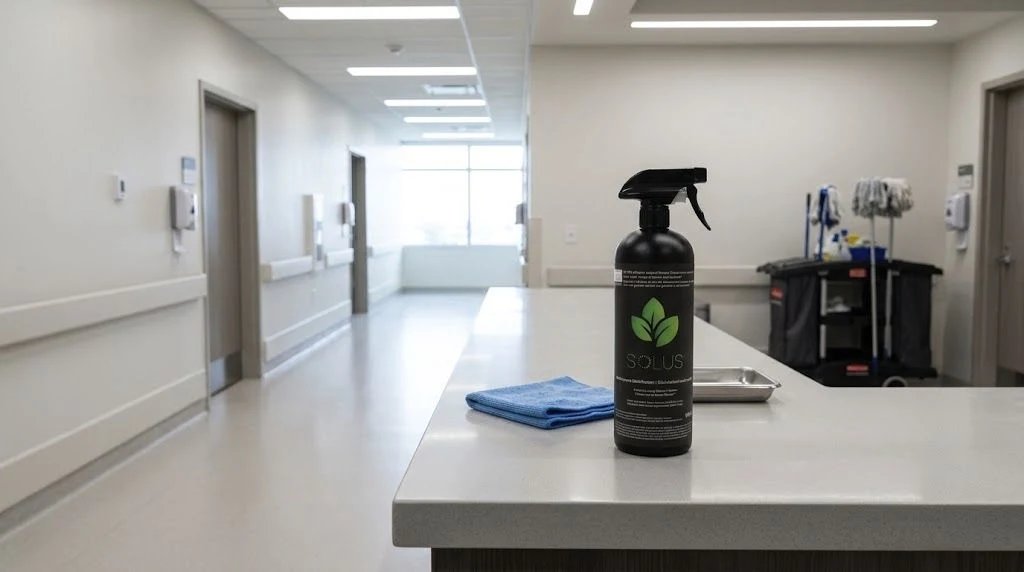
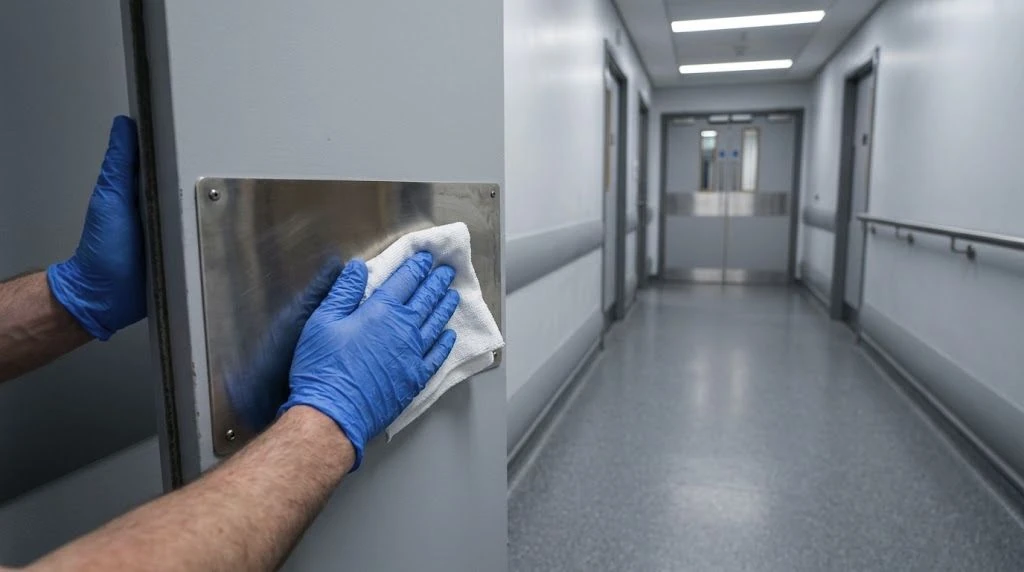
The scope is narrower than “hospital disinfectant” may sound. It covers authorized environmental hard surfaces when the product is used according to its current label. Examples can include a reception counter, corridor handrail, door push plate, exterior cabinet handle or hard bedside surface, provided that the surface and use are covered.
The authorization number is not an all-purpose permission. The label defines where the product may be used, how it is applied, wet contact time, precautions and rinsing. A facility should connect the authorization, label and FDS/SDS to its environmental-services procedure. A wall rail and an instrument used in patient care are different objects; manufacturer-specific or clinical reprocessing instructions continue to govern the latter.
Which environmental surfaces should receive priority?
Priority should follow actual touch patterns, not a list copied from another building. A facility can walk the route used by patients, visitors and staff, then assign repeatedly touched hard surfaces to a written routine. At reception, that may be a counter edge; in a waiting area, chair arms and door push plates; in a room, a light-switch plate, faucet handle, door handle or hard bedside-table exterior.
Frequency is not universal. A low-traffic consultation space and a busy entrance during respiratory-illness season have different touch loads. Set a baseline schedule, then add triggers such as visible soil, room turnover, high occupancy or a documented outbreak-control direction. Each trigger should identify who acts, which procedure applies and how completion is recorded.
The checklist should also flag objects handled under another protocol. That prevents staff from treating every nearby item as though the same label and contact time apply, and removes the need to make a scope decision from memory during a busy shift.
What does the Solus efficacy evidence show?
The table below is the single complete efficacy table for this article. It documents specific tested organisms and methods; it is not a blanket promise for every microorganism, surface, application method or clinical situation.
| Organism | ATCC | Protocol | Contact time | Report |
|---|---|---|---|---|
| Staphylococcus aureus | ATCC 6538 | AOAC Use Dilution Method; Analytical Lab Group, GLP | 10 minutes | A30442 |
| Salmonella enterica | ATCC 10708 | AOAC Use Dilution Method; Analytical Lab Group, GLP | 10 minutes | A30442 |
| Pseudomonas aeruginosa | ATCC 15442 | AOAC Use Dilution Method; Analytical Lab Group, GLP | 10 minutes | A30442 |
| Human Coronavirus 229E | ATCC VR-740 | Virucidal efficacy for use on inanimate environmental surfaces; Analytical Lab Group, GLP | 1 minute | A30618 |
| Influenza A (H1N1) | ATCC VR-1469 | Virucidal efficacy for use on inanimate environmental surfaces; Analytical Lab Group, GLP | 1 minute | A31073 |
Data last verified: August 2026.
The AOAC Use Dilution Method is reported here as a pass/fail carrier method, not as a log-reduction claim. The bacterial rows therefore state the method, organism, ATCC number, ten-minute contact time and report A30442 without adding a percentage. The viral rows likewise retain the exact organism, ATCC identifier, one-minute contact time and individual report number.
How should a label-led disinfection workflow be built?
A reliable workflow starts before the disinfectant is applied. The worker confirms the surface is within the procedure, removes disposable items or obstacles, and checks for visible soil. Cleaning removes soil that can block contact between the disinfectant and the hard surface. If the facility uses a separate cleaner, the procedure should name it and state any rinse or drying step required before disinfection.
Next, the worker applies the Multi-Purpose Disinfectant according to the label and records the 367 ppm label/FDS concentration. The surface remains visibly wet for the applicable contact time. If it dries early, the worker documents the failed check, reapplies as directed and restarts the full period.
A supervisor can audit the zone code, product, start and finish time, exception notes and sign-off. The record should show what surface was treated, whether it was cleaned first, what concentration was used, whether wet time was achieved and how a failure was corrected.
Label-led rinsing also remains part of the workflow. The current label for the Multi-Purpose Disinfectant recommends a potable-water rinse after application on surfaces or objects that may directly contact infants or toddlers, animals, food, feed or drinking water. A healthcare-facility authorization does not remove that instruction. The facility should identify those exceptional surfaces in advance instead of asking a worker to interpret the label during turnover.
For product selection and documentation, review the Solus product range and current Solus documents.
How do formulation and handling fit a facility procedure?
Solus’s Multi-Purpose Disinfectant is made by electrolysis of a 0.5% sodium chloride solution and water (SDS §3). The current SDS, prepared July 29, 2026, lists pH 5.0–7.0 and an oxidation-reduction potential of +600 to +1200 mV in §9. Those figures explain the product specification; they do not replace the directions and precautions on the label.
Follow the PPE requirements on the current product label and SDS; the SDS recommends eye protection where splashing is possible and gloves for prolonged or repeated contact or sensitive skin (SDS §8). Surface compatibility still depends on exposure and manufacturer instructions.
Where does the authorized scope stop?
This article is deliberately limited to environmental hard-surface disinfection in healthcare facilities. It does not claim sterilization, high-level disinfection, skin antisepsis, wound care or direct treatment of a person. It also does not turn a facility authorization into permission to reprocess instruments or other items controlled by manufacturer-specific or clinical reprocessing instructions.
The same boundary applies to application language. “For healthcare facilities” describes an authorized premises category; it does not mean “for every object found in a healthcare building.” The environmental-services procedure should name the surface, verify that it is hard and non-porous, and check the current label before use. If the status of an object is unclear, the worker should stop and refer it to the facility’s infection-prevention or reprocessing lead.
What does a practical room-turnover check look like?
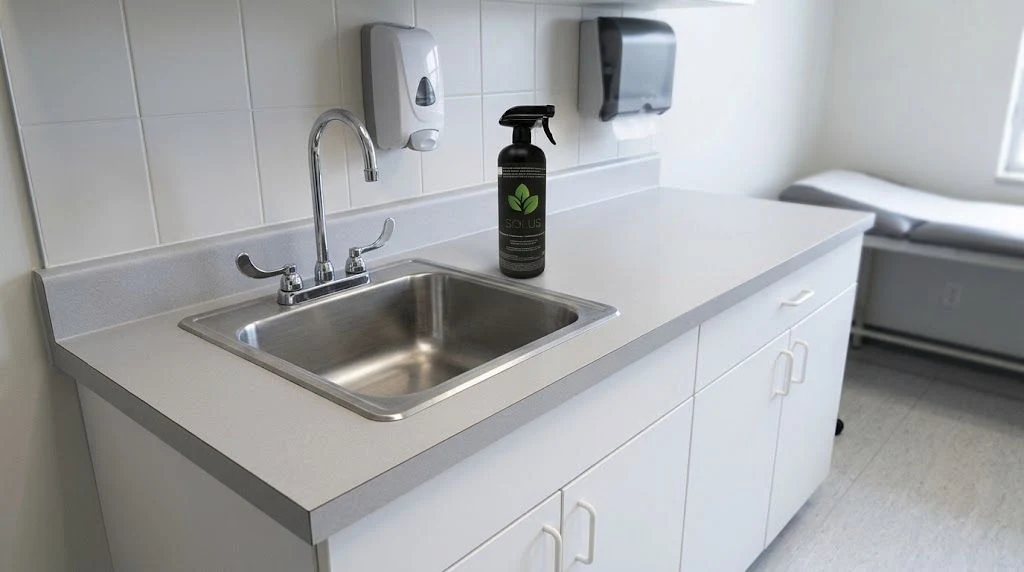
After a scheduled visit, a consultation-room checklist identifies the door handle, light-switch plate, faucet handle, counter edge and exterior cabinet pull. Staff remove waste, clear visible soil and complete cleaning before applying the Multi-Purpose Disinfectant only to listed surfaces for the applicable wet time.
If the faucet handle dries early, the worker records the deviation, reapplies as directed and restarts that surface’s contact period. The sign-off confirms the correction without implying that unlisted equipment was treated. The room returns to service under the facility’s criteria, supported by a repeatable surface list and audit trail.
Review the Solus product range when building a label-led environmental-surface procedure for a Canadian healthcare facility.
Frequently asked questions
Can the Multi-Purpose Disinfectant be used in Canadian healthcare facilities?
Yes, for authorized environmental hard-surface uses. Solus’s Multi-Purpose Disinfectant holds biocide market authorization no. 02557371 with Hospital / Health Care Facilities as an approved use area. The current label still controls the specific surface, application method, contact time, precautions and any required or recommended rinse.
Does the healthcare authorization cover every object in a hospital?
No. A premises category is not permission for every object inside the building. This article covers hard, non-porous environmental surfaces. Instruments and items governed by separate manufacturer or clinical reprocessing instructions must remain in those processes rather than being added to an environmental checklist.
What concentration should a facility document?
Document 367 ppm free available chlorine, the concentration on the current label and FDS/SDS. The procedure should identify the current product documents and avoid substituting a laboratory-lot range or a rounded number. Reconfirm the label and FDS/SDS version whenever the procedure is revised.
How long must a treated surface remain wet?
Follow the current label for the intended use. In the verified Solus evidence, the AOAC bacterial rows use a ten-minute contact time and the two virucidal environmental-surface rows use one minute. Keep each organism paired with its ATCC identifier, protocol and report number; do not turn those records into a universal time claim.
Is potable-water rinsing ever needed?
Yes. The current label recommends a potable-water rinse after application on surfaces or objects that may directly contact infants or toddlers, animals, food, feed or drinking water. The facility should identify those surfaces in its written procedure and preserve the label-led rinse instead of describing the Multi-Purpose Disinfectant as universally no-rinse.
Where can a reviewer find the supporting documents?
Use Solus documents for the current biocide authorization, FDS/SDS and laboratory materials. The healthcare sector page provides facility context, while the current label remains the operating authority for surface scope, contact time, precautions and rinsing. Confirm each file’s date and version before using it in a facility procedure.
Facilities that operate foodservice or shared public areas can align this procedure with HACCP sanitation documentation, commercial-kitchen disinfection workflows, and hotel high-touch-surface hygiene.
Procurement and training teams can compare HOCl and quaternary-ammonium disinfectants and adapt occupancy controls from daycare disinfection guidance without treating those sector pages as substitutes for the healthcare label.
Final thoughts
Healthcare environmental disinfection works best when the product claim, surface list and staff procedure say the same thing. Solus provides a Canadian biocide authorization for Hospital / Health Care Facilities, a current 367 ppm label/FDS concentration and organism-specific GLP evidence. A facility still needs to pre-clean, follow the label, control wet time, document corrections and respect the boundary between environmental surfaces and separately governed items.
The strongest procedure is therefore not the one with the broadest promise. It is the one an environmental-services lead can turn into a precise checklist and audit trail without adding a use, surface or outcome that the current label does not authorize.
See also
- HOCl vs bleach
- Is HOCl safe?
- Solus healthcare sector
- Solus product range
- Solus documents
Sources
- Health Canada biocide transition
- Solus documents — current biocide authorization, label/FDS/SDS and laboratory material.
- Solus healthcare sector — facility context only; the current label controls use.