
Direct answer
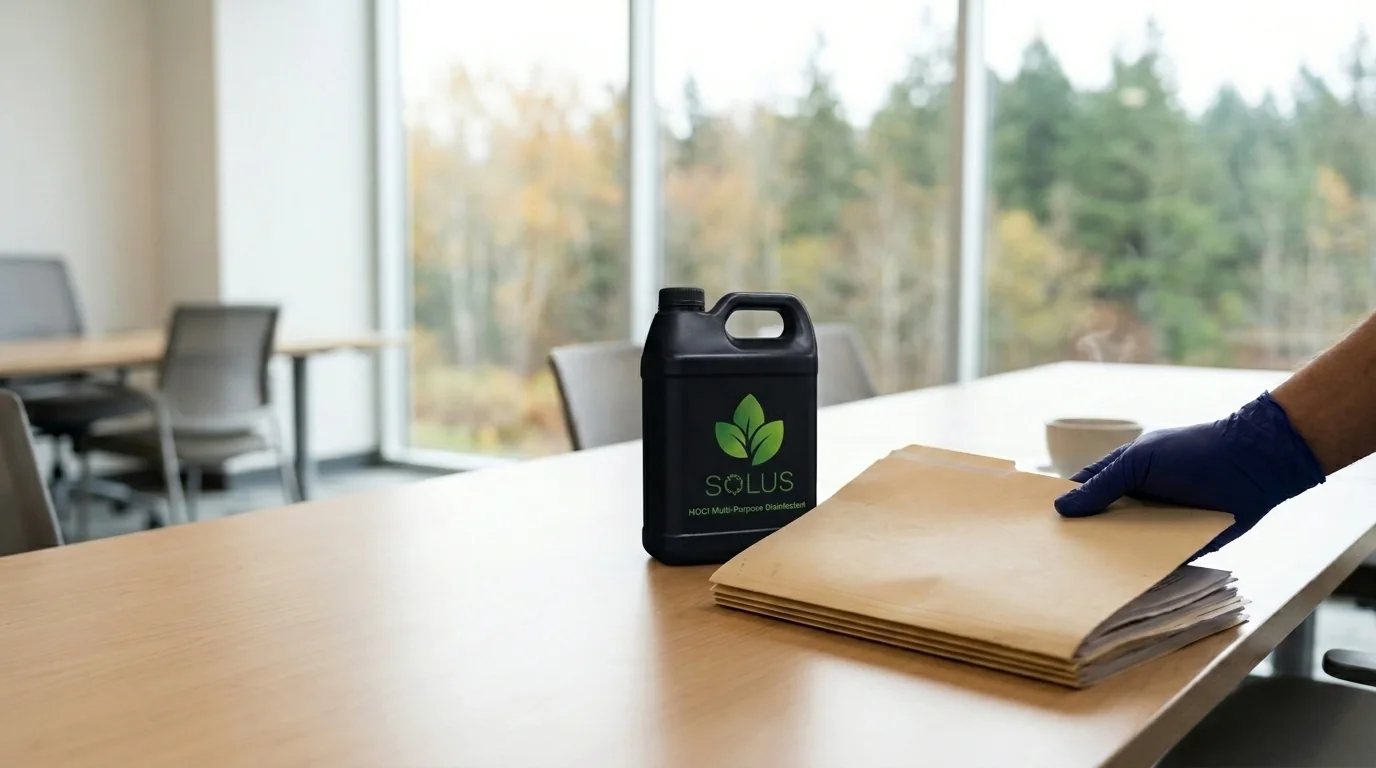
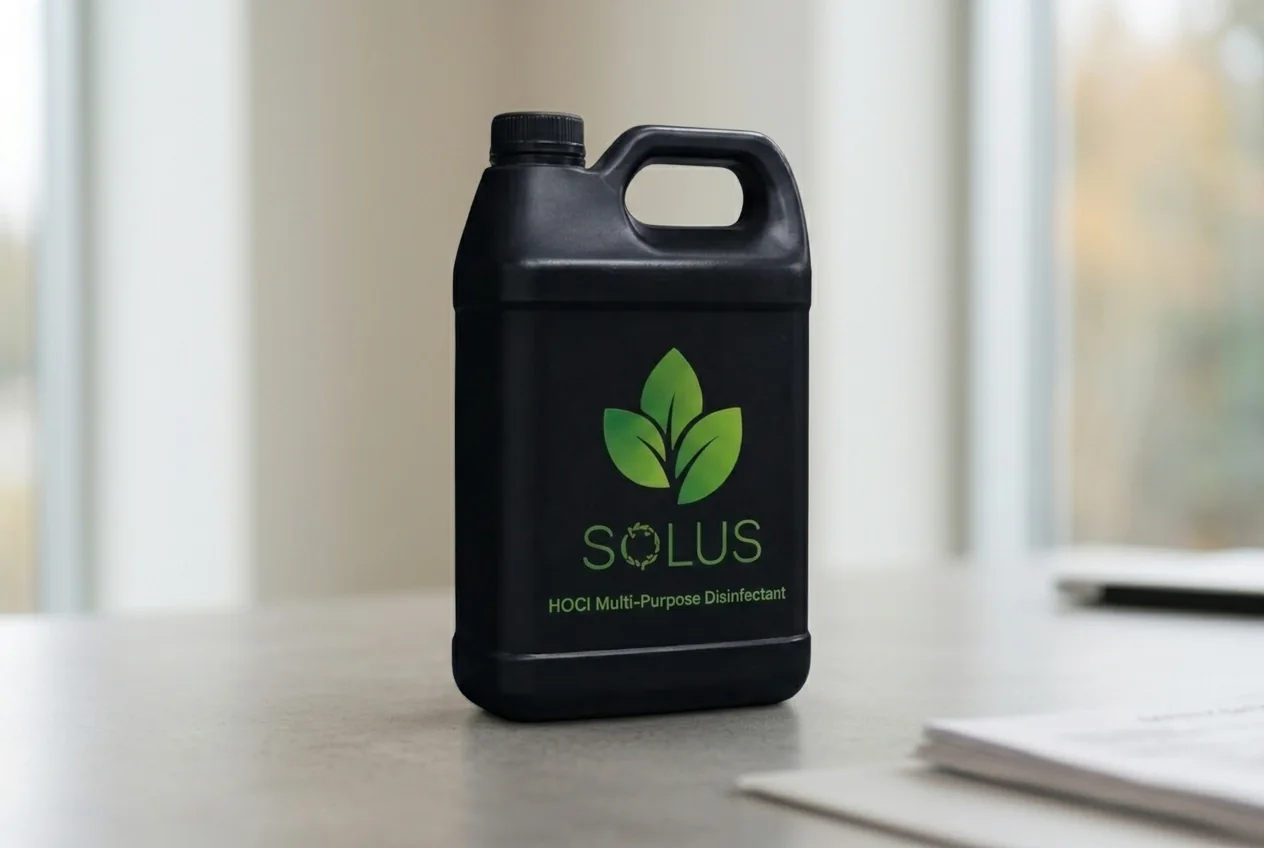
A Drug Identification Number (DIN) was the eight-digit number Health Canada assigned to a product it had reviewed and authorized — in Canada, hard-surface disinfectants were historically regulated as drugs, so they carried a DIN. Health Canada is now transitioning disinfectants to the Biocides Regulations, where the equivalent identifier is a biocide market authorization number. Solus’s Multi-Purpose Disinfectant holds Health Canada biocide market authorization no. 02557371 — the same number that superseded its DIN. That number confirms Health Canada authorized the product for specific, defined uses; it is not a quality rating, a ranking, or an all-purpose safety guarantee.
For an overview, see our hypochlorous acid (HOCl) guide.
Key takeaways
- A DIN was Health Canada’s identifier for a product it reviewed and authorized; disinfectants historically carried a DIN because they were regulated as drugs in Canada.
- Health Canada is transitioning disinfectants to the Biocides Regulations; the equivalent identifier is a biocide market authorization number.
- Solus’s Multi-Purpose Disinfectant now holds biocide market authorization no. 02557371 — the same number that superseded its DIN, not a new or second registration.
- Authorization no. 02557371 covers four use areas: Food Premises, Hospital / Health Care Facilities, Domestic, and Institutional / Industrial. The current label defines each authorized surface, method, contact time and rinse requirement.
- An authorization number certifies that a defined product was reviewed for defined uses; it does not certify every possible use, rank one product above another, or replace reading the current label.
On this page
- What was a Health Canada DIN?
- What is changing under the Biocides Regulations?
- What does authorization no. 02557371 actually cover?
- What a DIN or authorization number does NOT certify
- How do you verify a product’s authorization?
- Frequently asked questions
A registration number isn’t a gold star — it’s a promise that a specific product was reviewed for specific uses. The useful question is never “does it have a number,” but “what does the label attached to that number actually authorize.”
— Philippe Mathys, Solus
What was a Health Canada DIN?
A Drug Identification Number is an eight-digit number Health Canada assigns to a product it has assessed and authorized for sale in Canada. It signals that the department reviewed the product’s formulation, labelling, and intended use before it reached the market. Because Canada historically regulated hard-surface disinfectants as drugs under the Food and Drugs Act, a disinfectant carried a DIN rather than the kind of registration number used in other countries.
The number itself is an identifier, not a score. Two products with valid numbers are not automatically equivalent, and a number does not tell you which surfaces, contact times, or precautions apply. Those details live on the authorized label. The number’s real function is traceability: it ties a specific product and its authorized label to a Health Canada record you can check.
What is changing under the Biocides Regulations?
Health Canada is modernizing how it regulates disinfectants and sanitizers by moving them out of the drug framework and into a dedicated framework: the Biocides Regulations (SOR/2024-110) came into force on May 31, 2025. Under that framework, the market-facing identifier is the eight-digit identification number the Minister assigns to an authorized biocide — described in Health Canada’s plain-language guidance as a biocide market authorization number — rather than a DIN. Existing DIN-bearing disinfectants have a four-year transition window, to May 31, 2029, to obtain a biocide market authorization, and a transitioned disinfectant keeps the same eight-digit number, now issued as its biocide identification number. Surface sanitizers used in food premises have a longer six-year window, to May 31, 2031 (the date Health Canada describes the framework as fully in force), and generally follow a new-application pathway rather than the transition route. Because this product holds a DIN as a disinfectant, it falls under the four-year timeline. The regulatory home and the identifier’s name change, but the underlying expectation is unchanged: a product must be reviewed and authorized for defined uses before those claims can appear.
For Solus, the practical result is specific. The product’s registration moved from a DIN to a biocide market authorization, and it kept the same number — no. 02557371. There is one product and one authorization record, now expressed under the Biocides Regulations. When you see older material that refers to a “DIN” for this product, read it as the same product and number, now authorized under the Biocides Regulations. Always confirm the current identifier and label wording against the current Health Canada record and the product’s current label, because transition details and label text can be updated.

What does authorization no. 02557371 actually cover?
Authorization no. 02557371 covers four use areas: Food Premises, Hospital / Health Care Facilities, Domestic, and Institutional / Industrial. A “use area” describes the setting in which the product’s authorized hard-surface disinfection applies; it does not turn every task in that setting into an approved use. Within each area, the current label defines the specific surfaces, the application method, the contact time the surface must stay wet, any precautions, and whether a potable-water rinse is required.
Two boundaries matter when you read those use areas. First, an authorized use area covers disinfection of eligible hard, non-porous surfaces — not direct application to food, skin, animals, feed, or drinking water. Second, the label, not the use-area name, is the controlling document: confirm the intended surface, method, and contact time against the current label before writing the product into a procedure or an audit file. The Multi-Purpose Disinfectant’s current label concentration is 367 ppm free available chlorine, and its independently tested evidence is documented on the Solus documents page rather than implied from the authorization number.
What a DIN or authorization number does NOT certify
A registration number is often read as more than it is. It does not rank products, so a lower or higher number means nothing about performance. It does not certify efficacy against every organism — only the uses and claims Health Canada actually reviewed apply, and a product’s tested organisms are a defined list, not “everything.” It does not make a product safe for uses outside its label, and it does not authorize application to food, skin, or animals just because the product is authorized for surfaces in a food or health-care setting.
It also does not replace the label or the Safety Data Sheet. The number points to an authorized product and its label; the label and SDS tell you how to use it, how long to keep the surface wet, when to rinse, and what precautions apply. Treating the number as a blanket endorsement is the most common mistake in a written procedure. The defensible position is narrow and accurate: “this specific product holds Health Canada biocide market authorization no. 02557371 for these use areas, and we follow its current label.”
How do you verify a product’s authorization?
Start from the product’s current label and its stated authorization number, then confirm that number against Health Canada’s record for the product. Check that the use area you rely on — for example, Food Premises or Hospital / Health Care Facilities — is actually listed, and that the surface, method, and contact time you intend to use are on the current label. For a disinfectant in transition, confirm whether the current identifier is expressed as a DIN or a biocide market authorization, and use the wording that matches the current record.
Keep the evidence together for audits. For Solus’s Multi-Purpose Disinfectant, the current authorization, label, Safety Data Sheet, and independent laboratory reports are collected on the Solus documents page, so a procedure can cite authorization no. 02557371, the 367 ppm label concentration, and the specific tested organisms from a single source. Reviewing those documents before you rely on the product in a written procedure is the difference between citing a number and standing behind an authorized use.
Frequently asked questions
Is a DIN the same as a biocide market authorization number?
They serve the same identifying purpose at different points in Canada’s regulatory transition. A DIN was the identifier under the drug framework; a biocide market authorization number is the identifier under the Biocides Regulations. Solus’s Multi-Purpose Disinfectant now holds biocide market authorization no. 02557371 — the same number that superseded its DIN.
What does authorization no. 02557371 cover?
It covers four use areas: Food Premises, Hospital / Health Care Facilities, Domestic, and Institutional / Industrial. The current label defines each authorized surface, application method, contact time, precaution, and any required potable-water rinse. A use area authorizes disinfection of eligible hard surfaces, not direct application to food.
Does a DIN or authorization number mean a product is “non-toxic” or safe for any use?
No. The number certifies that a defined product was reviewed and authorized for defined uses. It does not certify safety for uses outside the label, does not rank products, and does not authorize application to food, skin, or animals. Follow the current label and Safety Data Sheet.
Why do some Solus materials still say “DIN”?
Because the registration moved from a DIN to a biocide market authorization under the Biocides Regulations while keeping the same number, 02557371. Older wording that says “DIN” refers to the same product and number, now authorized under the Biocides Regulations; on Health Canada’s record the former DIN is cancelled and marked ‘transitioned to biocides,’ and the number is now the product’s biocide identification number, not a current DIN. Confirm the current wording against the current label and Health Canada record.
Where can I verify Solus’s authorization?
Confirm the number and use areas against Health Canada’s record and the product’s current label, and review the current authorization, label, SDS, and laboratory reports on the Solus documents page (/document/) before relying on the product in a written procedure or audit file.
Final thoughts
A Health Canada DIN — and, under the Biocides Regulations, a biocide market authorization number — is a traceable promise that a specific product was reviewed for specific uses. It is not a ranking or a blanket safety claim. Solus’s Multi-Purpose Disinfectant holds authorization no. 02557371 for four defined use areas, with a 367 ppm label concentration and documented independent testing. Read the number as a pointer to the label, confirm the use area and directions, and keep the authorization, label, and SDS together for your records.
See also
- HACCP-compliant disinfectant
- How to disinfect a commercial kitchen
- HOCl vs bleach for Canadian facilities
- Solus documents and biocide authorization records — plain text; linked once above
Sources
- Health Canada — Drug Identification Number (DIN) fact sheet: https://www.canada.ca/en/health-canada/services/drugs-health-products/drug-products/fact-sheets/drug-identification-number.html
- Health Canada — Biocides (Biocides Regulations SOR/2024-110, in force 2025-05-31): https://www.canada.ca/en/health-canada/services/drugs-health-products/biocides.html
- Health Canada — Guidance on the transition of disinfectants and surface sanitizers to the Biocides Regulations: https://www.canada.ca/en/health-canada/services/drugs-health-products/biocides/guidance/transition-to-regulations.html
- Solus biocide market authorization no. 02557371 and current label — VERIFIED CLAIMS (Phil-confirmed same number Aug 10).
- Solus documents page (/document/) — authorization, label, SDS, Analytical Lab Group GLP reports A30442, A30618, A31073.