
Direct answer
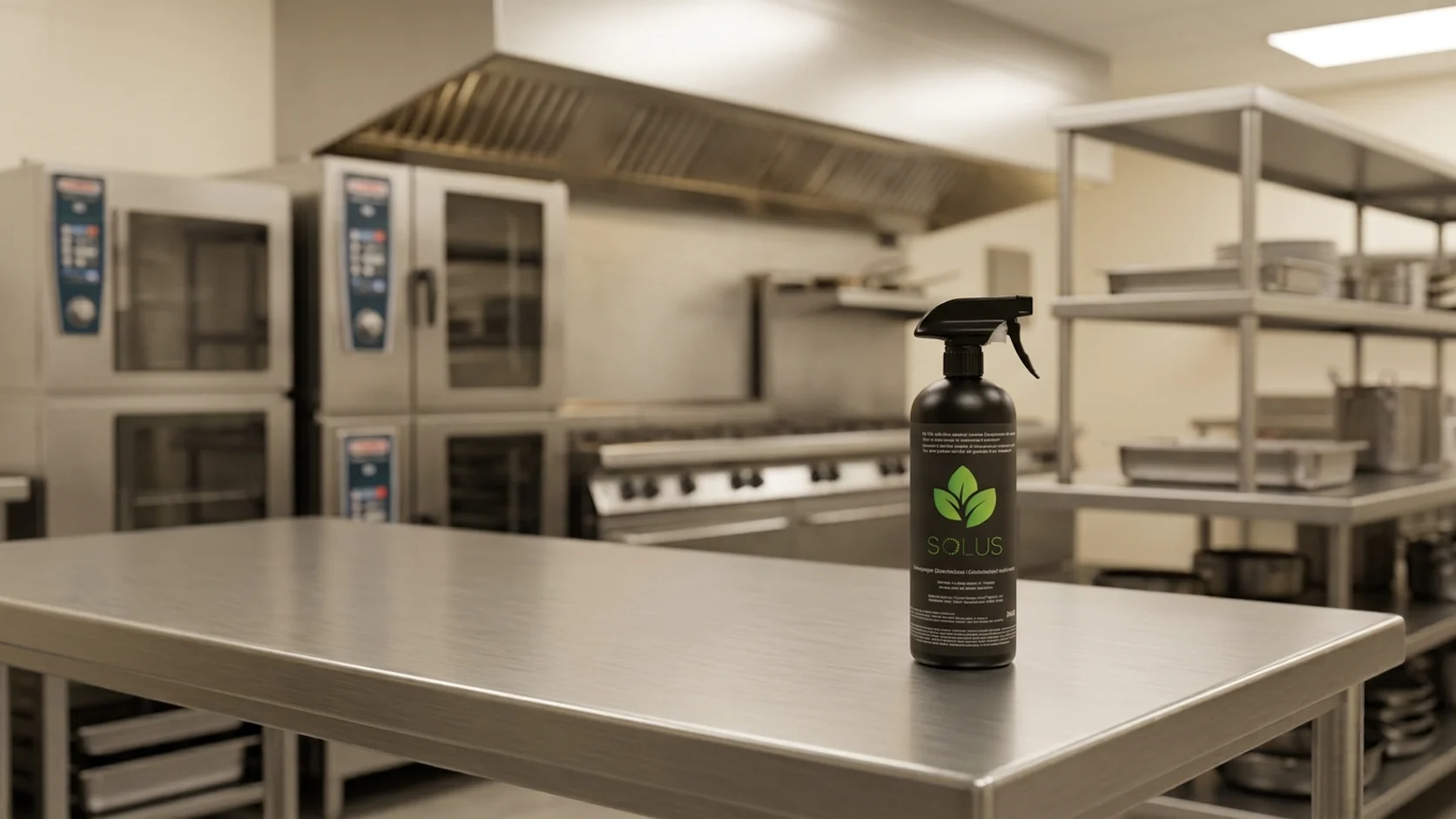
Commercial disinfecting in a kitchen starts with sequence, not spray volume: remove soil, wash with detergent, rinse, apply a product authorized for the intended surface, and keep the surface wet for the label contact time. Separate food-contact and high-touch zones. After application, use a potable-water rinse where the Multi-Purpose Disinfectant label recommends it for direct-contact surfaces or objects.
For an overview, see our hypochlorous acid (HOCl) guide.
Key takeaways
- Clean first. Organic soil can interfere with a disinfectant, so the SSOP should show debris removal, detergent cleaning, and rinsing before disinfection.
- Keep the surface wet for the complete label contact time; wiping early changes the procedure and should be recorded as a deviation when required.
- Use a zone plan: food-contact surfaces, high-touch non-food-contact points, and general surfaces have different priorities.
- The Multi-Purpose Disinfectant’s current label concentration is 367 ppm free available chlorine. Use the current label and FDS/SDS when documenting concentration.
- The Multi-Purpose Disinfectant label recommends potable-water rinsing after application for surfaces or objects that may directly contact infants or toddlers, animals, food, feed, or drinking water. Do not insert a universal “no-rinse” claim.
On this page
- What is the correct cleaning sequence?
- Which zones need the most attention?
- What does the test record document?
- How should contact time be managed?
- How should food-contact rinsing be handled?
- Frequently asked questions
A clean commercial kitchen comes down to sequence, not spray volume — clean first, hold the label contact time, then rinse the food-contact surfaces the label tells you to.
— Philippe Mathys, Solus
What is the correct cleaning sequence?
The Ontario food-premises regulation, Health Canada’s biocide transition guidance, and food-processing guidance all point to a practical sequence. A facility should adapt the sequence to its equipment, soil load, and approved product label rather than treating this article as a substitute for the SSOP.
- Remove debris. Scrape or pre-rinse visible food and soil.
- Wash. Use the kitchen’s approved detergent and mechanical action.
- Rinse. Remove detergent and loosened soil with clean water.
- Apply. Cover the hard, non-porous surface with the authorized product.
- Hold contact time. Keep the surface wet for the label time.
- Complete the zone step. Rinse with potable water after application where the label recommends it for direct-contact surfaces or objects; otherwise follow the label’s finish directions.
At end of service, the supervisor can close one grill-and-plating zone at a time instead of treating the whole kitchen as a single task. The outgoing team removes food, utensils, and loose debris, then records that service has stopped in that zone. Staff wash and rinse the food-contact parts, inspect for remaining soil, and separately identify high-touch controls and handles that require their own checklist line. The authorized product is applied according to the label, the required wet contact time is recorded, and the potable-water rinse is completed wherever the label directs or recommends it. The incoming shift reviews the completed zone, confirms that no corrective action remains open, and signs the handoff before food or clean utensils return to the surface. If a listed grill guard dried early or another component was missed, the zone remains open while the affected step is repeated and documented.
Which kitchen zones need the most attention?
| Zone | Examples | Documentation focus |
|---|---|---|
| Food-contact | Prep tables, cutting boards, slicers, utensils, food-processing equipment | Product authorization, contact time, and potable-water rinse where recommended by the label |
| High-touch, non-food-contact | Handles, switches, taps, touchscreens, refrigerator doors | Frequency based on traffic, visible soil, and SSOP |
| General | Floors, walls, equipment exteriors | Scheduled cleaning and spill response |
Data last verified: August 2026 from the linked Canadian guidance.
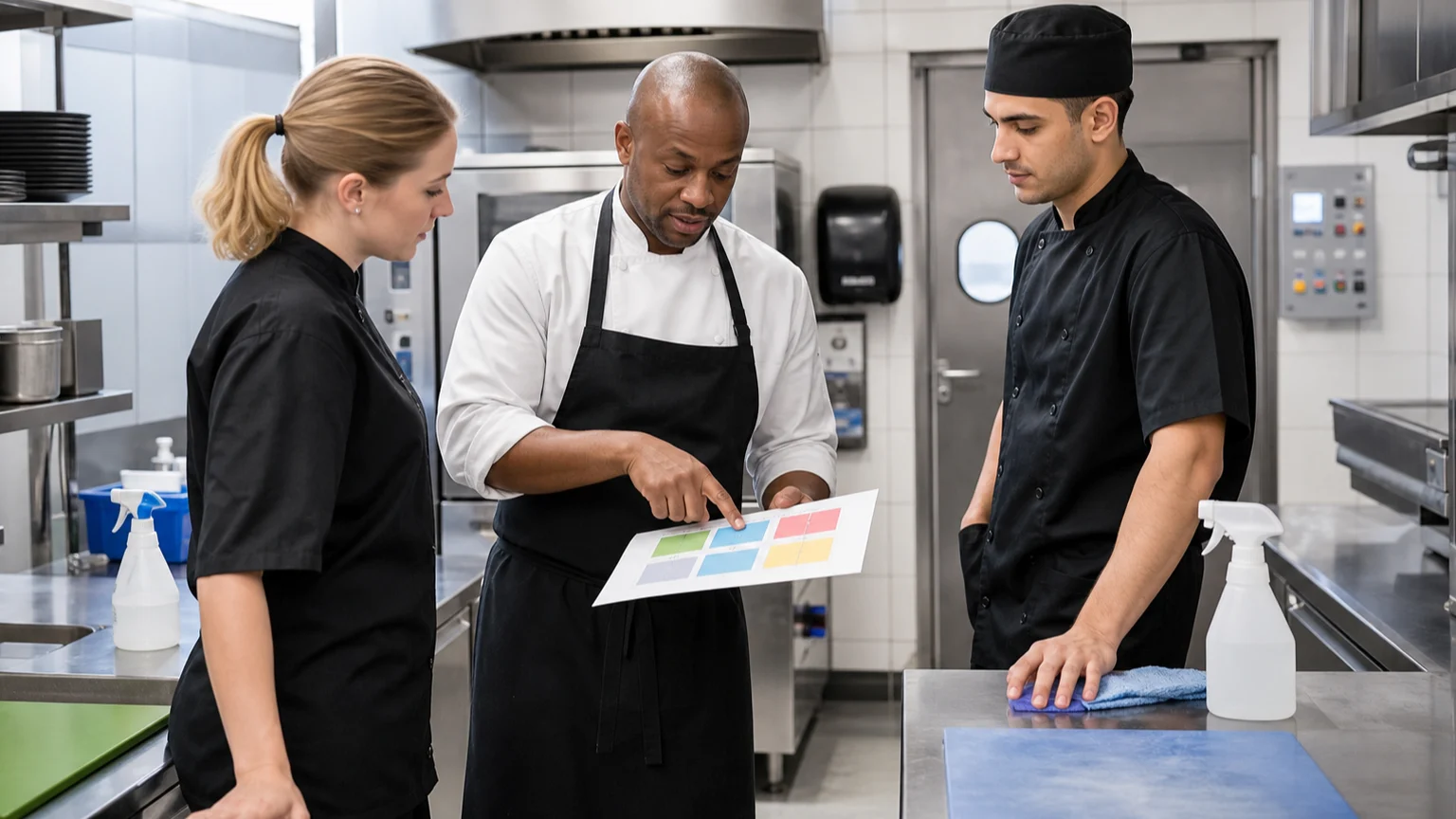
The goal is a repeatable handoff between cleaning and food production. Colour-coded zones, signed checklists, and a clear responsible role help a supervisor see whether the step happened without pretending that one frequency fits every kitchen.
Two common mistakes happen when staff classify an entire workstation instead of each surface. On a slicer station, the blade, food carriage, and catch tray may contact food, while the power switch and adjustment knob are high-touch controls. They should not automatically share the same cleaning record or rinse decision; each task follows the applicable label and SSOP. On a mixer, the bowl and paddle are food-contact parts, but the housing, speed control, and nearby refrigerator handle are not. A colour-coded map should therefore name the component, not just “slicer” or “mixer.”
A second confusion appears during mid-shift touch-ups. Wiping a refrigerator handle after repeated glove contact does not replace the scheduled food-contact procedure for the cutting board beside it, and completing the cutting-board procedure does not document the handle. Separate checklist lines, tools assigned by the facility, and responsible roles make both tasks visible without treating them as identical.
Prep sinks create the same classification problem. A sink basin used to rinse ingredients or hold food-contact utensils belongs in the food-contact workflow, while the tap handles and soap-dispenser lever are high-touch controls unless the facility’s actual use makes them food-contact. On a prep table, the worktop and cutting board may contact food, but the front edge, adjustment knob, and underside are normally separate touchpoints. Reach-in and walk-in door handles are high-touch surfaces; an interior shelf or pan that supports unpackaged food may require a food-contact procedure.
Raw and ready-to-eat work adds another operational distinction. A board and knife used for raw poultry require the facility’s controlled raw-food cleaning sequence before reuse, while a separate board used for ready-to-eat garnish follows its assigned procedure. The refrigerator handle touched between those tasks is not automatically a food-contact surface, but it is a high-touch transfer point that still needs a defined response. Naming each component and its use prevents staff from classifying an entire station by convenience and helps the supervisor verify that both workflows were completed.
What does the Solus test record document?
The table below is the complete tested-efficacy reference for this product. Any later efficacy sentence should point to the table instead of repeating an incomplete organism, time, or concentration claim.
| Organism | ATCC | Protocol | Contact time | Report |
|---|---|---|---|---|
| *Staphylococcus aureus* | ATCC 6538 | AOAC Use Dilution Method; Analytical Lab Group GLP | 10 minutes | A30442 |
| *Salmonella enterica* | ATCC 10708 | AOAC Use Dilution Method; Analytical Lab Group GLP | 10 minutes | A30442 |
| *Pseudomonas aeruginosa* | ATCC 15442 | AOAC Use Dilution Method; Analytical Lab Group GLP | 10 minutes | A30442 |
| Human Coronavirus 229E | ATCC VR-740 | Virucidal efficacy for inanimate environmental surfaces; Analytical Lab Group GLP | 1 minute | A30618 |
| Influenza A (H1N1) | ATCC VR-1469 | Virucidal efficacy for inanimate environmental surfaces; Analytical Lab Group GLP | 1 minute | A31073 |
The full supporting set is in the Solus evidence documents. The table does not expand the label’s scope to every organism, surface, or application method.
How should contact time be managed?
Contact time is the interval the treated surface remains visibly wet, as directed by the product label. A worker should plan the task so another job does not dry the surface early. If the surface dries or is wiped early, the supervisor should follow the facility’s deviation procedure rather than silently treating the step as complete.
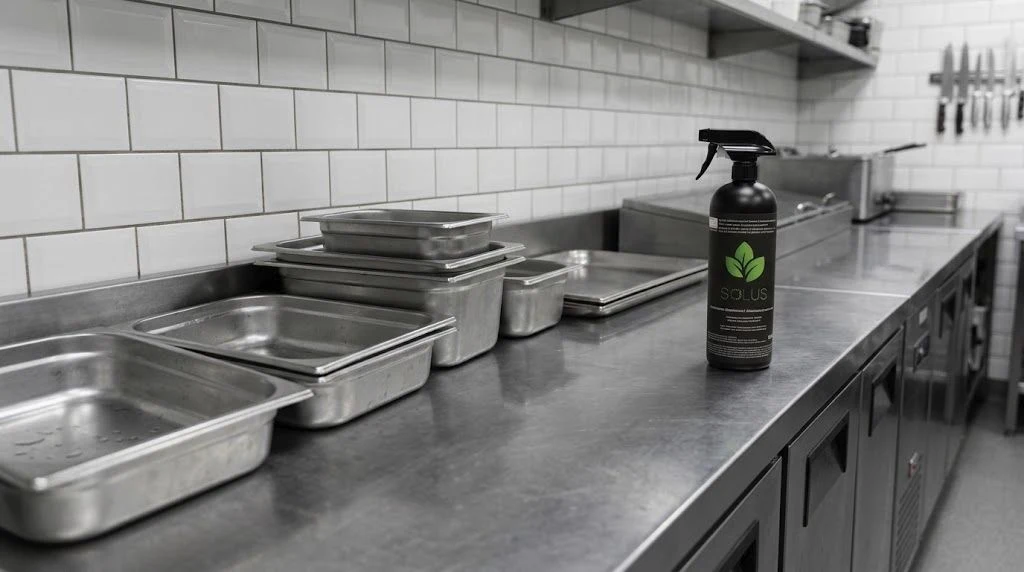
For the Multi-Purpose Disinfectant, 367 ppm is the current label figure. Use the current label and FDS/SDS in the SSOP, and do not use the efficacy table to imply a new dilution or a broader claim than the label supports.
How should food-contact rinsing be handled?
The current label for the Multi-Purpose Disinfectant states that rinsing with potable water is recommended after application for surfaces and/or objects that may come into direct contact with infants or toddlers, animals, food, feed, or drinking water. Build that step into the kitchen SSOP where it applies and do not describe the Multi-Purpose Disinfectant as universally “no-rinse.”
How often should commercial disinfecting be scheduled?
There is no single schedule for every operation. Build frequency around food-contact exposure, soil load, turnover, staff traffic, spills, and the facility’s SSOP. A product-change or task-change schedule may make sense for a busy prep line, while high-touch non-food-contact points may need a separate risk-based interval. Document the reason for the chosen interval.
A useful schedule separates three types of triggers. Routine triggers cover the checkpoints already defined in the SSOP, such as a shift change or a planned production change. Event-driven triggers cover spills, unexpected soil, or a task that introduces a new exposure. Corrective triggers apply when a surface dries before the full label contact time, a rinse is missed, or the record is incomplete. For each action, the log should identify the zone, date and time, employee, product, contact time, required potable-water rinse, and any corrective step. That record shows why the work was repeated instead of relying on a vague instruction to disinfect “often.”
How should a facility choose a disinfectant?
Use a product whose biocide market authorization no. 02557371 and label match the intended premises and surface. Review the label, FDS/SDS, contact time, application method, and documentation package. The Solus product range and Solus documents are internal starting points; they do not replace the kitchen’s own label review or SSOP.
For supplier and format checks before ordering, see where to buy HOCl in Canada.
Frequently asked questions
What is the first step when disinfecting a commercial kitchen?
Remove visible debris, wash with detergent, and rinse before applying a disinfectant. The product should be authorized for the intended surface, and the surface must remain wet for the full label contact time. Record the procedure in the SSOP and complete the potable-water rinse where the label recommends it.
How long should a surface stay wet?
Use the contact time printed on the label. The Solus evidence table pairs each organism with its ATCC number, protocol, contact time, and report number. Do not generalize one test result to every organism or surface, and do not wipe the product dry before the label interval is complete.
What concentration appears on the Multi-Purpose Disinfectant label?
The current label concentration is 367 ppm free available chlorine. Use the current label and FDS/SDS in the SSOP; do not substitute a test-lot range.
Should food-contact surfaces be rinsed?
Yes, where the current label for the Multi-Purpose Disinfectant recommends it. After application, rinse with potable water when a surface or object may come into direct contact with infants or toddlers, animals, food, feed, or drinking water. Do not describe the product as universally “no-rinse.”
How should high-touch points be scheduled?
Use a risk- and traffic-based schedule inside the SSOP. Handles, taps, switches, screens, and refrigerator doors may need more frequent attention than low-touch walls or floors. Record the chosen frequency, the person responsible, and what happens when visible soil or a spill requires an extra pass.
Facilities that manage both kitchens and other occupied spaces can align this workflow with healthcare environmental-disinfection procedures and daycare high-touch-surface routines. Before writing staff instructions, review HOCl safety for surface disinfection.
Final thoughts
A commercial kitchen disinfection program is a controlled sequence: clean, rinse, apply an authorized product, hold the label contact time, and complete the food-contact step confirmed by the label. The value of a product is easier to audit when its label, FDS/SDS, test record, and SSOP all tell the same story.
See also
- HACCP-compliant disinfectant
- HOCl vs bleach for Canadian facilities
- Solus product range
- Solus evidence documents
- Hotel and hospitality hygiene
Sources
- Ontario Regulation 493/17 — Food Premises
- Health Canada — Transition to the Biocides Regulations
- Toronto Public Health — Cleaning and sanitation of food-contact surfaces
- Public Health Ontario — Best practices for environmental cleaning
- Solus authorization records — confirm current versions at publication.