
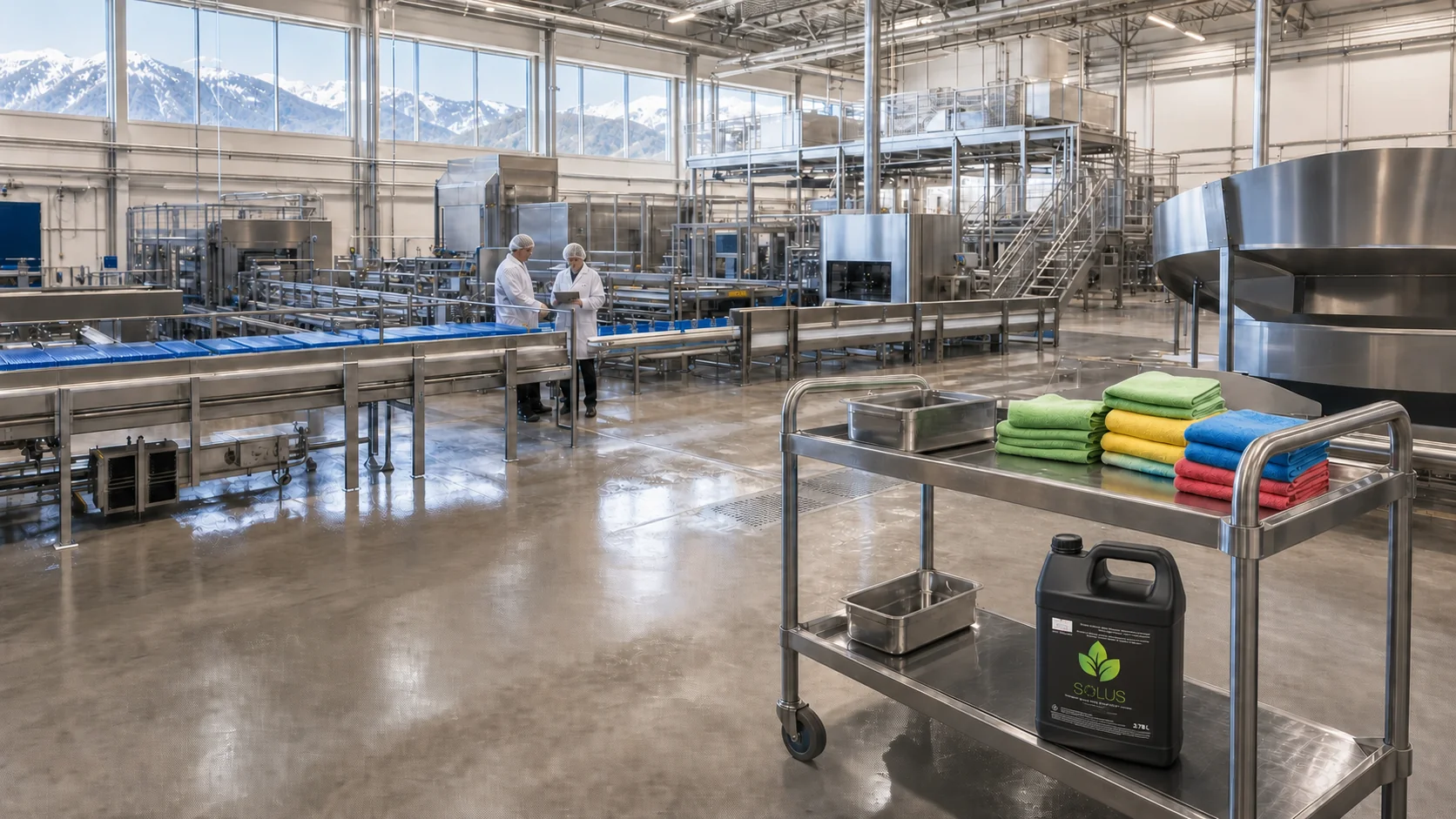
Solus’s Multi-Purpose Disinfectant and quaternary ammonium compounds (quats) are hard-surface disinfectants with different operating profiles. The Multi-Purpose Disinfectant is near-neutral; follow its current label for rinsing and residue management; quats are cationic surfactants that tend to leave residue on treated surfaces (EPA, 2024). Product choice should follow each authorized label, surface, contact time, rinse and handling requirement.
For this guide’s place within the wider topic, see our hypochlorous acid resource hub.
Key takeaways
- Follow the current Multi-Purpose Disinfectant label for rinsing and residue management. Quats tend to leave residues; in EPA testing, quats left the most residue among disinfectant classes after a potable-water rinse (EPA, 2024).
- The complete GLP evidence table below documents each tested organism, ATCC identifier, protocol, contact time, Analytical Lab Group GLP status and report number.
- HOCl is near-neutral (pH 5.0 to 7.0, SDS §9). In the WHO EML submission, MSF describes HOCl generally as “non-toxic, non-corrosive” (attributed to MSF, not a product claim for the Multi-Purpose Disinfectant).
- Quats can be reduced by organic matter, hard water, and anionic detergents or soaps (EPA, 2020; Arnold et al., 2023). HOCl is also reduced by organic load, so both work best on pre-cleaned surfaces.
- Quats are linked to antimicrobial-resistance determinants such as qac genes, though real-world impact is debated (Larocchi et al., 2023). No established broad acquired resistance to HOCl (Winter et al., 2020). Quats are also associated with occupational asthma (Migueres et al., 2021).
What are quats, and how do they differ from HOCl?
Quats (quaternary ammonium compounds, e.g. benzalkonium chloride, didecyldimethylammonium chloride) are cationic surfactants used widely as surface disinfectants. They work mainly by disrupting the cell membranes of microorganisms and tend to adsorb to and leave residues on treated surfaces (EPA, 2024; Arnold et al., 2023).
For the relationship between electrolysis and HOCl, see electrolyzed water and HOCl explained.
HOCl works differently. It is an oxidant. The Multi-Purpose Disinfectant is made by electrolysis of a dilute salt solution and water, is near-neutral at pH 5.0 to 7.0. Follow the current label for rinsing and residue management.
For facility teams, that difference matters operationally: HOCl use still requires review of the specific label for residue management, ventilation and repeated surface treatment. Quats remain useful in many programs, but they need careful product-by-product review for residue, contact time, surface compatibility, and labelled use.
What must Canadian facilities use?
In Canada, hard-surface disinfectants and other surface biocides are regulated under the Biocides Regulations, which came into force on May 31, 2025. Products need a Health Canada market authorization for their specific claims and use areas. Solus’s Multi-Purpose Disinfectant is authorized under biocide market authorization no. 02557371; Health Canada retained the same eight-digit sequence during the transition. A quat product used for the same claim needs its own market authorization — check its authorized label.
How do HOCl and quats compare?
Scroll table sideways on mobile.
For a broader class comparison, see our guide to choosing disinfectants in Canada.
| Factor | Multi-Purpose Disinfectant | Quaternary ammonium (quats) |
|---|---|---|
| How it works | Oxidation (active HOCl at pH 5.0–7.0) | Cationic surfactant; disrupts cell membranes |
| In-use free available chlorine | Approximately 367 ppm free available chlorine at the label/SDS use concentration | Not chlorine-based; in-use active per label dilution — check the product’s authorized label |
| Residue after use | Follow the current label for rinsing and residue management. | Tends to leave residues; most residue of the classes in EPA testing (EPA, 2024) |
| Food-contact surfaces | Authorized (biocide market authorization no. 02557371, Food Premises); rinse with potable water after use, per the label | Product-specific: follow the authorized label and any potable-water rinse requirement (EPA, 2020; Health Canada, Biocides transition guidance) |
| Organic matter / hard water | Reduced by organic load; pre-clean first | Reduced by organic load, hard water, anionic detergents (product-dependent) |
| Verified GLP evidence | See the complete table below; every row includes the organism, ATCC identifier, protocol, contact time, Analytical Lab Group GLP status and report number. | ~4–10 min wet contact (≥4 min is a common labeled minimum); varies with active concentration and formulation — check the product’s authorized label (2025 review) |
| Resistance concerns | No established broad acquired resistance (Winter et al., 2020) | Linked to qac resistance genes; field impact debated (Larocchi et al., 2023) |
| Handling | Follow the PPE requirements on the current product label and SDS; glasses if splashing, gloves if prolonged/repeated or sensitive skin (SDS §8). | Associated with occupational asthma / respiratory irritation, esp. sprays/mists (Migueres et al., 2021) |
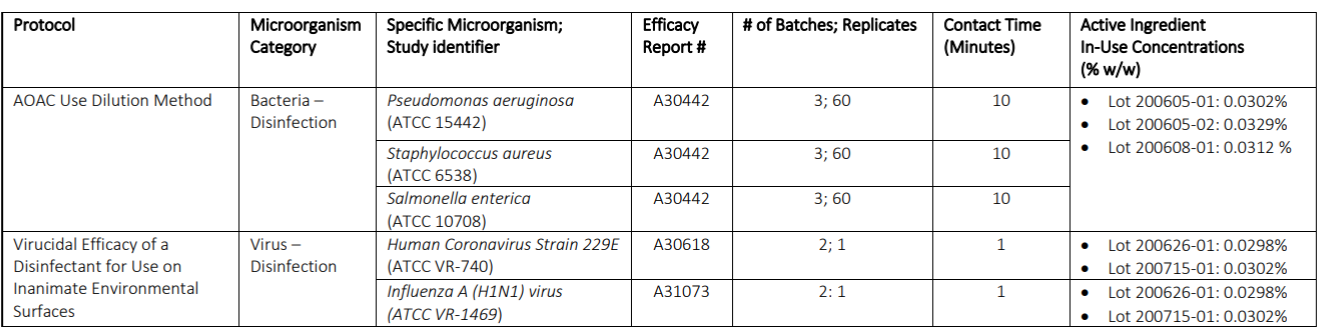
Multi-Purpose Disinfectant GLP test details
Scroll table sideways on mobile.
| Organism | ATCC # | Protocol / laboratory | Contact time | Report # |
|---|---|---|---|---|
| Staphylococcus aureus | 6538 | AOAC Use Dilution Method; Analytical Lab Group, GLP | 10 min | A30442 |
| Salmonella enterica | 10708 | AOAC Use Dilution Method; Analytical Lab Group, GLP | 10 min | A30442 |
| Pseudomonas aeruginosa | 15442 | AOAC Use Dilution Method; Analytical Lab Group, GLP | 10 min | A30442 |
| Human Coronavirus 229E | VR-740 | Virucidal efficacy protocol for inanimate environmental surfaces; Analytical Lab Group, GLP | 1 min | A30618 |
| Influenza A H1N1 | VR-1469 | Virucidal efficacy protocol for inanimate environmental surfaces; Analytical Lab Group, GLP | 1 min | A31073 |
Data last verified: August 2026.
Note on corrosivity: product-, pH-, and concentration-specific for both chemistries — compare specific product labels. Solus’s Multi-Purpose Disinfectant is formulated near-neutral (pH 5.0–7.0).
Comparing options for a facility? Start with the job: food-contact surface, healthcare environmental surface, residue-sensitive workflow, or routine general disinfection. Then verify the authorized label, contact time, rinse requirements, and handling instructions. See the Multi-Purpose Disinfectant range and the lab reports and biocide authorization.
How do residue, resistance and organic soil affect the choice?
Residue. Quats are surfactants that adsorb to surfaces; EPA’s 2024 residue testing found quats left the most residue of the disinfectant classes studied, even after a potable-water rinse (EPA, 2024). Follow the current Multi-Purpose Disinfectant label for rinsing and residue management.
Resistance. Quat use has been linked to reduced susceptibility and to resistance determinants such as qac genes; the mechanisms and gene associations are established, though broad population-level impact in routine use is debated (Larocchi et al., 2023; Lu et al., 2019). HOCl’s oxidative mechanism is different; microbes mount transient stress defenses rather than an established acquired resistance to it (Winter et al., 2020).
Organic soil. This cuts both ways. Quats can be reduced by organic matter, hard water, and anionic detergents (EPA, 2020; Arnold et al., 2023). HOCl is also consumed by organic load (Steinhauer et al., 2020). The takeaway for both: clean first, then disinfect.
Which fits food processing?
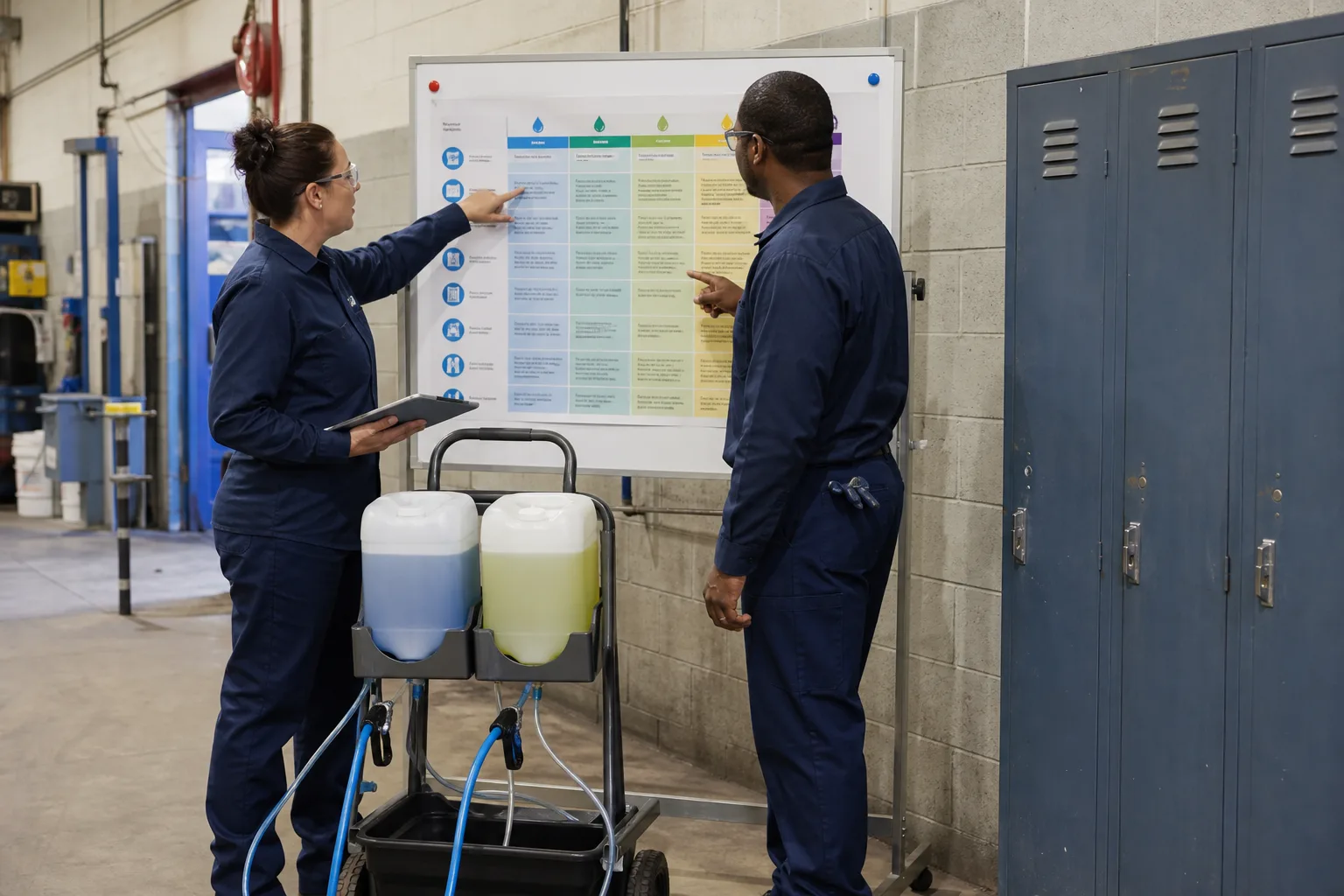
For food processing, the current label governs residue management: Solus’s Multi-Purpose Disinfectant is authorized for food-contact surfaces under biocide authorization documentation. Follow the current label for rinsing and residue management. Rinse food-contact surfaces with potable water after use, per the label. The label also recommends potable-water rinsing after application on surfaces or objects that may come into direct contact with infants or toddlers, animals, food, or drinking water.
Which fits healthcare?
For environmental hard surfaces in healthcare, use a product whose Health Canada market authorization includes Hospital/Health-Care Facilities, then follow the labelled organism, surface and contact-time directions. Multi-Purpose Disinfectant authorization no. 02557371 includes Hospital/Health-Care Facilities among its authorized use areas. This is hard-surface disinfection, not high-level disinfection or sterilization of semi-critical or critical medical instruments. Quat products vary by formulation, so facilities should verify each product’s authorized label and material-compatibility directions.
Quats are widely used. For the other comparison buyers ask about, see HOCl vs bleach. The point is that for buyers weighing residue, resistance, and handling, HOCl and quats are not interchangeable. For the underlying lab data, see the certifications and lab reports.
Where is HOCl not the right choice?
No single disinfectant fits every job. HOCl is a hard-surface disinfectant, so it is not the tool for high-level disinfection or sterilization of semi-critical or critical medical instruments — those need dedicated high-level disinfectants or sterilants. It also underperforms on heavily soiled surfaces if you skip pre-cleaning, because organic load consumes it (as it does quats). And where a deliberately persistent surface residual is wanted, a residue-leaving chemistry may suit that specific goal. Matching the chemistry to the task is the point — for hard-surface disinfection with a no-residue profile, HOCl fits well.
Frequently asked questions
What is the difference between HOCl and quats?
HOCl is an oxidant that is near-neutral (pH 5.0 to 7.0) and must be used according to its current label, including rinse directions. Quats are cationic surfactants that disrupt cell membranes and tend to leave residues (EPA, 2024). See how HOCl also compares with HOCl vs bleach.
Do quats leave a residue?
Yes. In EPA’s 2024 testing, quats left the most residue of the classes studied, even after a potable-water rinse. Follow the current Multi-Purpose Disinfectant label for rinsing and residue management when treating hard surfaces repeatedly.
Is HOCl more effective than quats against viruses?
The current evidence does not support a universal chemistry-wide ranking. Use the complete table above: it keeps each tested organism paired with its ATCC identifier, protocol, contact time, Analytical Lab Group GLP status and report number. Then compare the authorized label and conditions for the specific quat product.
Do quats or HOCl stop working on dirty surfaces?
Both can lose performance when organic soil blocks surface contact. Quats can also be affected by hard water and anionic detergents. Remove visible soil and complete the required cleaning step before either disinfectant is applied, then follow the product-specific label contact time and rinse directions.
Is HOCl safer to handle than quats?
The Multi-Purpose Disinfectant from Solus is not WHMIS-regulated or dangerous goods for transport in Canada (SDS §§14–15). Follow the PPE requirements on the current product label and SDS; the SDS recommends eye protection where splashing is possible and gloves for prolonged or repeated contact or sensitive skin (SDS §8). Quat handling varies by product and application method.
Teams applying this comparison can pair it with HOCl safety and handling guidance, commercial-kitchen disinfection steps, and healthcare environmental-surface protocols.
Final thoughts
For facilities weighing residue, resistance, and handling, HOCl and quats are not interchangeable. The Multi-Purpose Disinfectant from Solus has a near-neutral formulation, no lasting residue, and no established broad acquired resistance. Clean surfaces first, rinse food-contact surfaces with potable water after use where required by the label, and confirm handling instructions before rollout. Browse the Multi-Purpose Disinfectant range or the lab reports and biocide authorization.
See also
Sources
- U.S. EPA. Finalized Test Methods for Measuring Disinfectant Residue Levels on Hard Surfaces. 2024.
- Arnold WA, et al. Quaternary Ammonium Compounds: A Chemical Class of Emerging Concern. Environ Sci Technol. 2023.
- U.S. EPA. Label Requirements for Pesticides Used for Sanitation of Food-Contact Surfaces. 2020.
- Health Canada. Transition to the Biocides Regulations.
- 2025 review of quaternary ammonium disinfectants and labeled contact times.
- Larocchi et al. Antimicrob Resist Infect Control. 2023.
- Lu J, et al. 2019.
- Migueres N, et al. J Allergy Clin Immunol Pract. 2021.
- Steinhauer K, et al. Hypochlorous Acid: A Review. 2020.
- Winter et al. Responses of Gram-Negative Bacteria to Hypochlorous Acid. 2020.
- WHO/MSF. Hypochlorous acid EML application A.18. 2021 cost benchmark.
- Solus lab reports and biocide authorization